
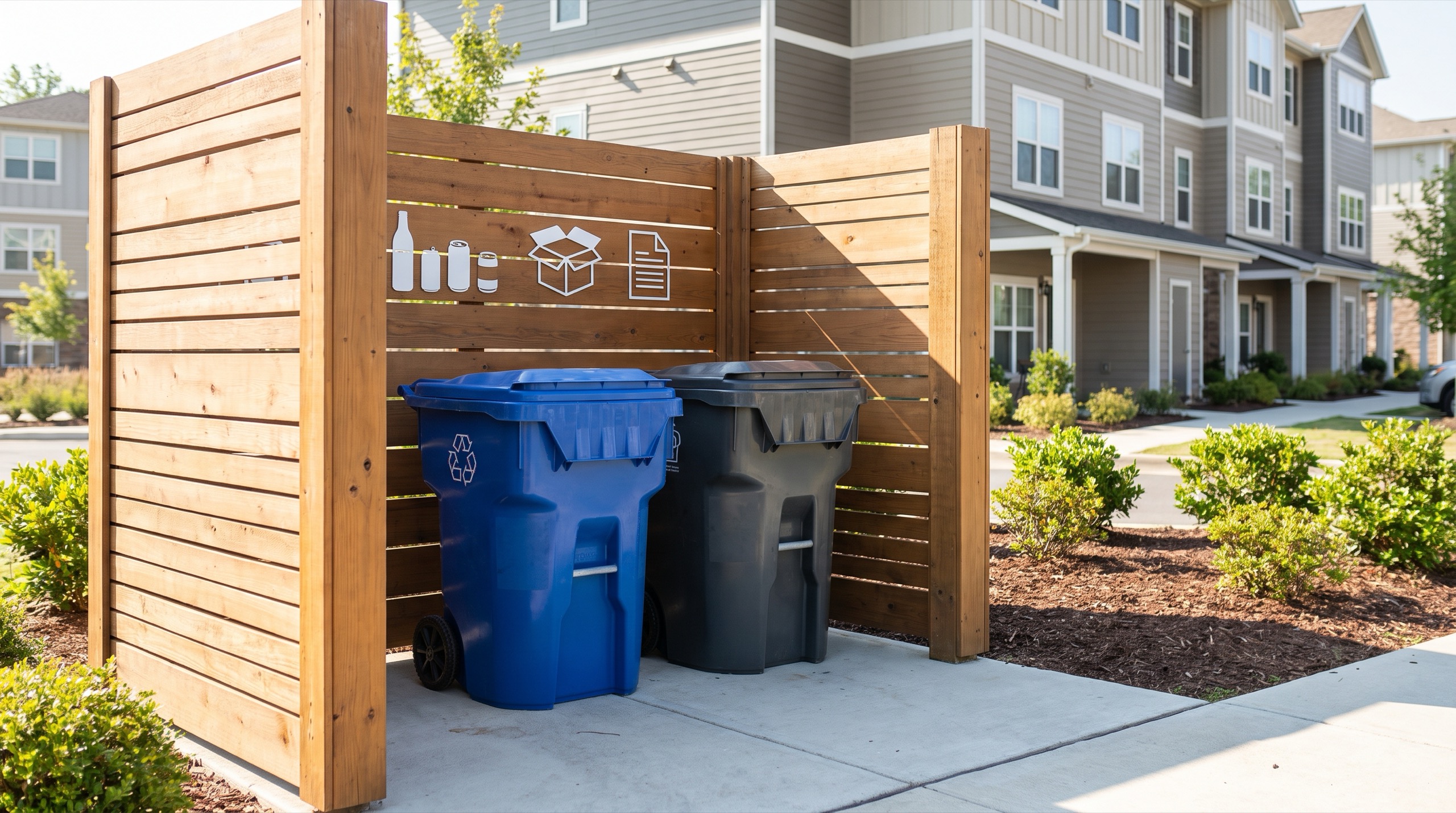
Most guides about apartment recycling start by telling you to rinse your cans. That’s fine advice, but it skips the part that actually decides whether recycling works where you live. Only 37 percent of the more than 30 million multifamily homes in the United States have recycling access at all, according to The Recycling Partnership’s State of Recycling report. Single-family homes sit at 85 percent.
That gap is the whole story. Apartment recycling isn’t harder because renters care less. It’s harder because the infrastructure often isn’t there, and where it is there, it’s frequently placed, sized, and labeled in ways that guarantee contamination. We collect waste at apartment communities every night, so we see which programs work and which ones quietly fail. This guide covers both sides: what residents can do inside a unit that has no room for three bins, and how property managers design a program that actually diverts material instead of just adding a blue cart nobody uses correctly.
Only 37 percent of US multifamily homes have recycling access, compared with 85 percent of single-family homes, and nearly 20 million apartment households are effectively excluded. Where local rules require multifamily recycling, on-property access jumps to 90 percent. Residents can recycle effectively with one small in-unit bin and the empty, clean, and dry rule from the EPA. Property managers should size containers at one-quarter cubic yard per three residents split between recycling and trash, place recycling as conveniently as trash, use pictogram signage, refresh outreach every four to six months, and audit the stream twice a year.
Last updated: August 2026. We refresh this page as recycling access data and state and local multifamily requirements change.
Why Apartment Recycling Fails More Often Than It Should
How big is the gap between apartment and house recycling?
It’s enormous, and it starts with access rather than behavior. The Recycling Partnership’s national data puts single-family recycling access at 85 percent and multifamily access at 37 percent, with all US households averaging 73 percent. That means nearly 20 million apartment households, 63 percent of all multifamily homes, are effectively excluded from recycling before anyone decides whether to rinse a jar.
The reason is mostly bureaucratic. Apartment communities are frequently classified as commercial properties, so they fall outside the municipal residential collection programs that serve houses on the same street. Your neighbor in a townhouse gets a city cart. Your 240-unit community gets a private hauling contract that may or may not include a recycling stream, depending on what someone signed years ago.
What changes when a city requires multifamily recycling?
Almost everything. The Recycling Partnership’s State of Recycling 2024 report found that in places where local authorities require multifamily recycling, 90 percent of multifamily homes have on-property access. Where some requirement exists, access is 60 percent. Where there’s minimal or no regulation, it collapses to 6 percent.
Read those three numbers again, because they’re the most useful data point in this entire guide. Apartment recycling access is not a function of resident demand, building age, or rent tier. It tracks local rules almost perfectly. If you’re a resident wondering why your community has no recycling, the answer usually lives at city hall, not in the leasing office.
How much material is being lost?
Roughly 7.5 million tons a year are lost specifically because multifamily homes aren’t adequately supported to participate in recycling, per the same report. For context, US recycling activities generated 681,000 jobs and $37.8 billion in wages in a single year, according to the EPA. Apartment communities are sitting on a material stream that already has a market waiting for it.
What Can You Actually Recycle From an Apartment?
Which materials are almost always accepted?
Four families of material make up nearly everything worth putting in an apartment recycling cart: corrugated cardboard, paper, metal cans, and rigid plastic bottles and jugs. Cardboard and paper carry the most weight in the system. Paper and paperboard accounted for roughly 67 percent of all the material the US recycled in EPA’s most recent national accounting, and it was recycled at a 68.2 percent rate.
The categories below cover the vast majority of what leaves an apartment unit. The “check locally” column is not a hedge. Accepted materials genuinely differ by hauler and by processing facility, which is why the EPA tells people to confirm with their local program rather than assume.
| Almost always accepted | Almost never accepted curbside | Check locally |
|---|---|---|
| Flattened corrugated cardboard | Plastic bags and film wrap | Glass bottles and jars |
| Mixed paper, mail, magazines | Electronics and batteries | Cartons for milk and broth |
| Aluminum and steel cans | Textiles and clothing | Plastic tubs and lids |
| Plastic bottles and jugs | Foam packaging and cups | Shredded paper |
| Cardboard boxes from deliveries | Food-soaked paper and napkins | Aerosol cans |
Why do plastic bags cause so much trouble?
Because they wrap around the spinning equipment at sorting facilities and shut the line down. The EPA is direct about it: plastic bags and wraps, electronics, and textiles generally cannot go in a curbside recycling bin. Grocery and department stores that collect film separately are the right destination for bags.
This matters twice as much at an apartment community. Residents carrying recycling down two flights of stairs naturally reach for a bag, then toss the whole bagged bundle into the cart. The material inside may be perfect, but a bagged load often gets treated as trash because nobody at the facility is going to open it.
How Do You Recycle in an Apartment That Makes It Hard?
What’s the simplest setup for a small unit?
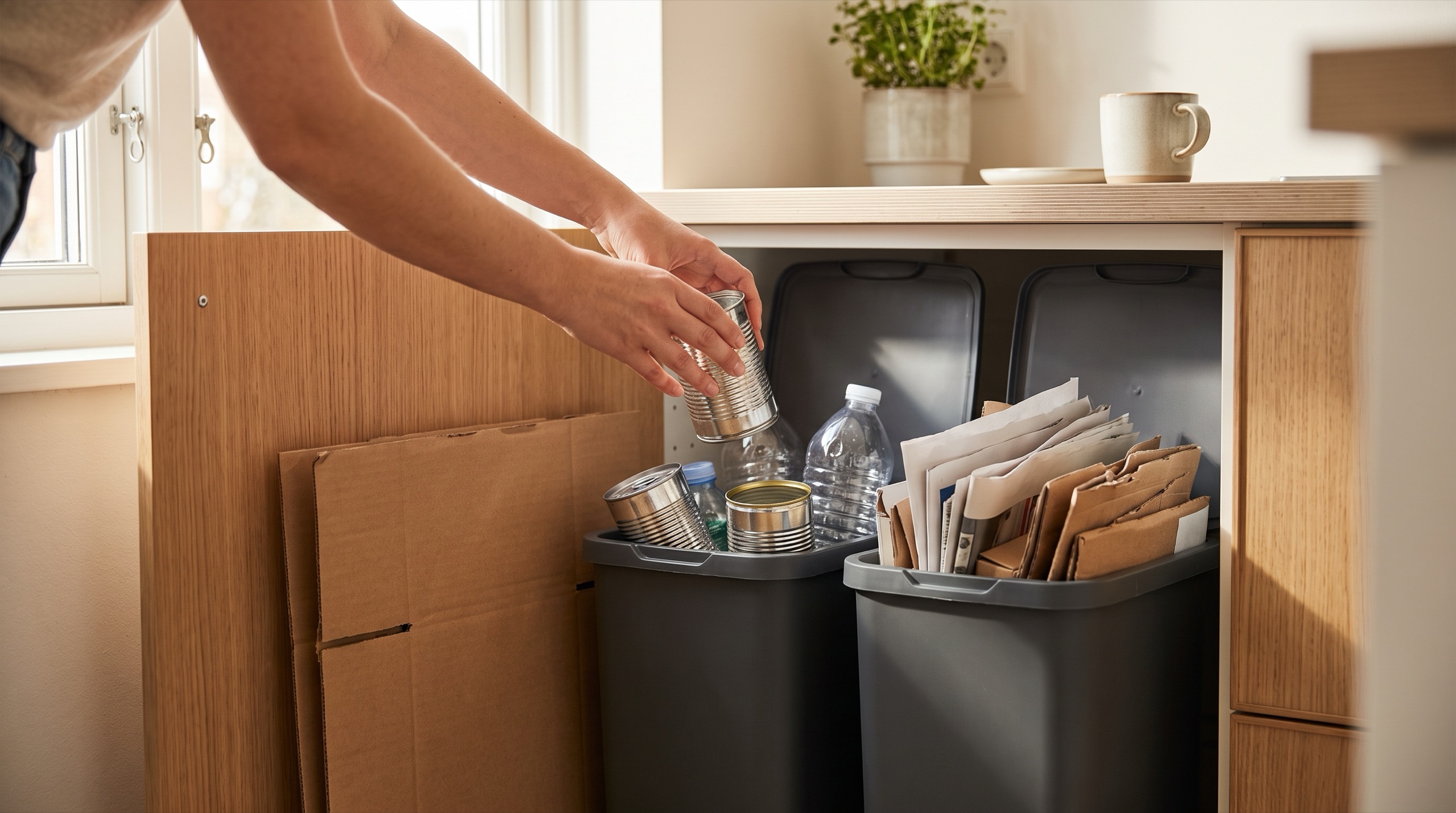
One bin, one habit. You don’t need a three-stream sorting station in a 700 square foot apartment. Most apartment communities and municipal haulers run single-stream recycling, meaning paper, cardboard, cans, and bottles all go into the same container. So put one lidded bin or a sturdy reusable tote wherever you actually generate the material, which for most people is between the kitchen counter and the front door.
The second half is the trip. A small in-unit bin fills every three or four days, which is exactly the cadence to pair it with something you already do, like taking out the trash or leaving for work. If your community uses doorstep collection, that trip gets shorter still.
Does everything really need to be rinsed?
Empty, clean, and dry is the standard. The EPA’s guidance is that plastic, metal, and glass must be empty and rinsed clean of food debris, and paper must be empty, clean, and dry. That does not mean scrubbing a peanut butter jar until it sparkles. A quick swirl of leftover dishwater is enough for most containers.
Dry matters more than people expect. A wet pizza box or a soaked stack of paper contaminates the fiber around it, and fiber is the highest-value material in the cart. If something is greasy or soaked through, it belongs in the trash, and the greasy part of a pizza box can be torn off while the clean lid still gets recycled.
What if my building doesn’t offer recycling at all?
You have three moves, in order of effort. First, check whether your city or county runs public drop-off centers, which many do for free and which accept cardboard and commingled containers. Second, ask the leasing office directly whether recycling can be added at the next hauling contract renewal, and put it in writing so it lands in the maintenance or ownership record. Third, check whether your city has a multifamily recycling requirement already on the books that your property may not be meeting.
That third one surprises people. In cities with a multifamily mandate, access runs around 90 percent, which means a property without recycling in one of those cities is the exception, not the rule.
What Contaminates an Apartment Recycling Stream?
Why does contamination matter so much?
Because it can void an entire load. The EPA notes that non-recyclable items can contaminate a whole load of recyclables and cause all of it to be thrown out, and that the wrong items cause costly damage to sorting equipment and raise facility costs. One resident emptying a kitchen trash bag into the recycling cart can undo the careful work of forty units.
Apartment recycling streams run dirtier than single-family streams for structural reasons rather than attitude. Containers are shared and anonymous, they’re often placed next to or inside the trash enclosure, and turnover means a fresh wave of residents arrives every month who never saw whatever signage went up last spring.
| Contaminant | Why it shows up at apartments | The fix that works |
|---|---|---|
| Bagged recyclables | Residents carry material downstairs in a bag and toss the bag in | Signage and move-in packets that say empty the bag, keep the bag |
| Whole bags of household trash | Recycling cart sits closer than the compactor, or trash is full | Never let trash capacity run short, and separate the two placements |
| Food and liquid residue | No rinse habit, small kitchens, shared containers | Empty, clean, dry messaging repeated at least twice a year |
| Bulk items and furniture | Move-outs treat any open container as a dumpster | Scheduled bulk pickup and a move-out waste policy in the lease |
| Unflattened cardboard | Delivery volume, and one box can fill a quarter of a cart | Break-down reminders and dedicated cardboard capacity |
Can contamination actually be reduced, or is it just the cost of doing business?
It can be reduced substantially. The Recycling Partnership reports that targeted recycling engagement and behavior interventions have cut contamination in half and increased material collected by as much as one-third. In one documented case in Reynoldsburg, Ohio, a series of cart tags using plain, non-judgmental messaging drove a 38 percent increase in average recycling route tonnage.
The lesson we’d draw from operating at communities is narrower: contamination responds to friction, not to lectures. When the correct behavior is the easiest one available at 9pm in the rain, the stream stays clean. When it isn’t, no poster fixes it.
How Do You Design a Program Residents Will Actually Use?
What does the research say about placement?
Recycling containers should be at least as convenient as trash containers. That’s the National Apartment Association’s explicit recommendation, and it’s the single most violated rule in multifamily waste design. Communities routinely put the compactor at the center of the property and the recycling cart at the back corner of the parking lot, then wonder why participation is low.
Participation is fragile even under good conditions. Nationally, 43 percent of households participate in recycling, and among households that have access, only 59 percent use their recycling service. Of those who do use it, only 57 percent of their recyclable material actually makes it into the container. Every added step of inconvenience takes another slice out of that funnel.
What signage and outreach cadence works?
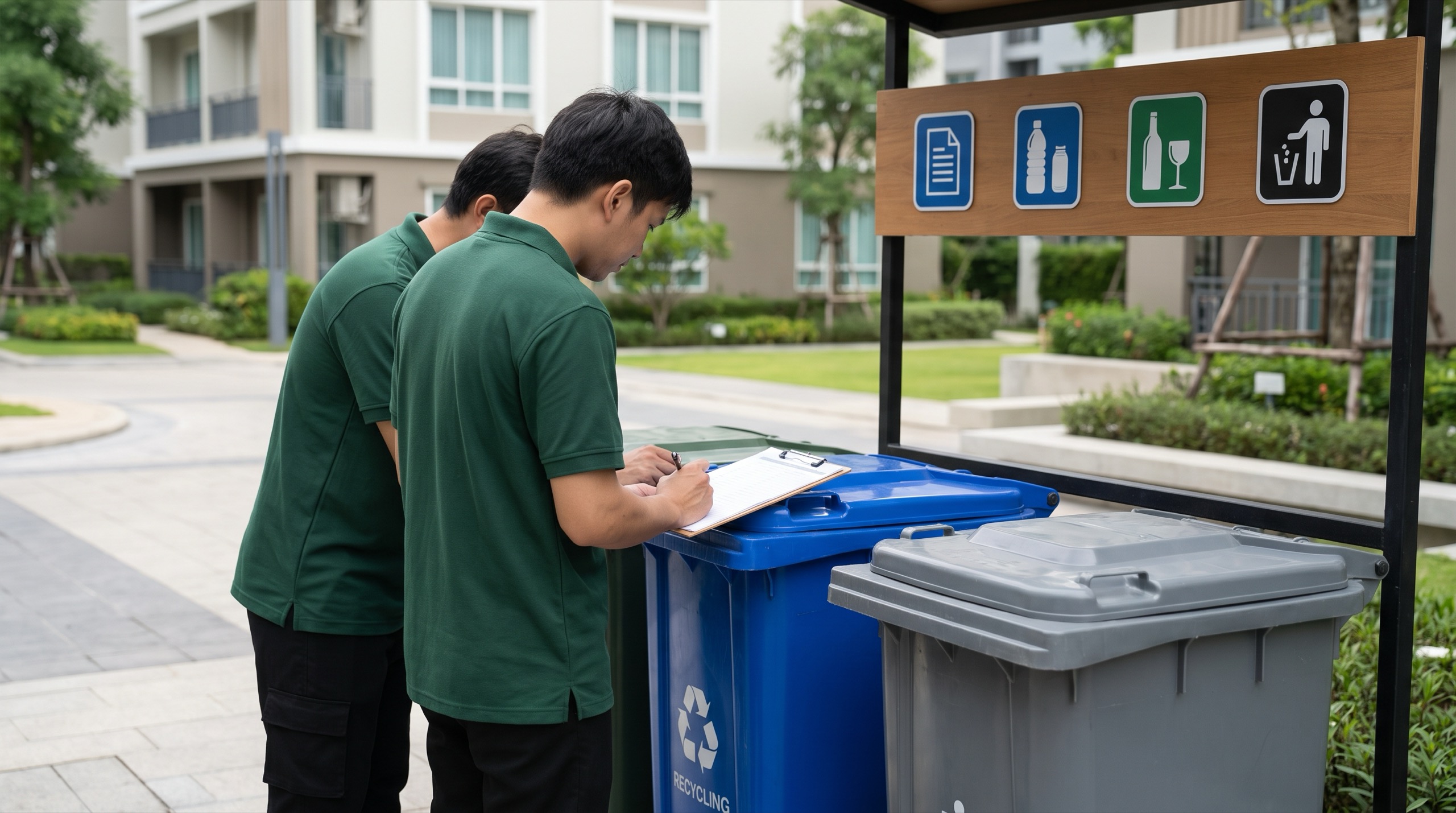
Color-coded signage with visual illustrations, refreshed on a schedule. The NAA recommends prominent color-coded signage showing what goes where, plus resident outreach at minimum every four to six months. That cadence exists because of turnover. In a community with 50 percent annual turnover, a sign posted once reaches only half the people living there a year later.
The most effective versions we see are boring and specific. Photographs or pictograms of the six items that matter most at that property, mounted at eye level at the point of disposal, in the languages residents actually speak. Long lists of rules on a laminated sheet do very little.
Are resident incentives worth running?
Sometimes, and they’re cheaper than most managers assume. The NAA describes resident monitor programs where a resident volunteer receives a modest rent reduction in the $50 to $150 range in exchange for keeping an eye on the recycling area and helping neighbors sort correctly. At a 200-unit property, that’s a rounding error against the hauling savings a clean stream produces.
Consumer support is not the constraint here. The NAA cites Carton Council research finding 94 percent of consumers are supportive of recycling and 74 percent say it’s important and should be a priority. The willingness is already in the building.
How Much Recycling Capacity Does a Community Need?
Is there a formula?
There’s a usable starting point. The NAA’s guidance is one-quarter cubic yard of container capacity per three residents, split equally between recycling and trash. That gives you a defensible baseline to take into a hauler negotiation instead of accepting whatever container mix the last contract happened to include.
Run it against your actual population, not your unit count. A 200-unit community averaging 1.8 residents per unit has roughly 360 residents, which is a very different capacity requirement than 200.
| Community size | Approx. residents at 1.8 per unit | Total capacity baseline | Recycling half |
|---|---|---|---|
| 100 units | 180 | 15 cubic yards | 7.5 cubic yards |
| 200 units | 360 | 30 cubic yards | 15 cubic yards |
| 300 units | 540 | 45 cubic yards | 22.5 cubic yards |
| 400 units | 720 | 60 cubic yards | 30 cubic yards |
Treat these as weekly service capacity to be met through some mix of container size and pickup frequency, then adjust from what you observe. Two smaller pickups usually beat one large one, because a cart that overflows on day five teaches residents that the recycling area is unreliable.
Where does cardboard blow up the math?
Delivery volume is the variable that breaks capacity plans. Corrugated boxes are bulky, they arrive constantly, and an unflattened box occupies several times its collapsed volume. Communities that add dedicated cardboard capacity, or that run a break-down campaign at move-in and during the holidays, buy back a surprising amount of room in the general recycling containers. We wrote a resident-facing explainer on this in Is Cardboard Recyclable?.
What Does an Apartment Recycling Program Cost?
Is recycling an added expense or a substitution?
Mostly a substitution, which is the part that gets missed in budget conversations. Material that goes into a recycling container is material that does not go into the compactor, so recycling service partially replaces trash disposal cost rather than stacking on top of it. The savings show up on the trash side of the invoice, in fewer compactor hauls or a smaller container.
The costs that are genuinely new are usually one-time: signage, container purchases if the hauler doesn’t supply them, and enclosure modifications if there’s no room for a second stream. The recurring line is the service itself, and its net cost depends heavily on how clean the stream stays.
| Line item | Type | What drives it |
|---|---|---|
| Recycling collection service | Recurring | Container volume and pickup frequency |
| Contamination surcharges | Recurring, avoidable | Loads rejected or downgraded to trash |
| Signage and resident education | One-time plus refresh | Turnover and language mix |
| Containers and enclosure work | One-time | Whether the hauler supplies carts |
| Reduced trash hauls | Recurring offset | Diversion rate and compactor cycles |
| Staff labor on the waste area | Recurring offset or cost | Overflow cleanup and sorting time |
The one line that ruins otherwise sound programs is contamination surcharges. A load that gets rejected doesn’t just lose its recycling value, it gets billed as disposal, so the property pays for the recycling pickup and the landfill tipping fee on the same material. That is why the education and placement work in the previous section is a financial decision, not a sustainability gesture.
Is Multifamily Recycling Required by Law?
Where do requirements already exist?
In a growing number of states and cities, and the trend is one direction. California’s AB 341 has required multifamily residential dwellings of five units or more to arrange recycling service since July 1, 2012, per CalRecycle. California later went further with SB 1383, which requires every jurisdiction to provide organic waste collection service to all residents and businesses, a shift we covered in our apartment composting guide.
Local ordinances matter as much as state law. Per the same Recycling Partnership report, Orlando’s 2019 ordinance required recycling across the city’s 75,000 multifamily residential units, and the resulting rollout added recycling access for nearly 50,000 homes that now divert 1,200 new tons of recyclables annually.
Finding out where your property stands takes about twenty minutes. Start with your city or county solid waste department, since multifamily requirements are usually written into the local solid waste ordinance rather than the building code, then check whether your state has a commercial or organics diversion law that reaches residential properties above a unit threshold. If your portfolio spans multiple metros, do this per jurisdiction. Requirements vary enormously between neighboring cities, and the property manager who assumes one market’s rules apply everywhere is the one who gets surprised.
| Jurisdiction | Requirement | Applies to |
|---|---|---|
| California (AB 341) | Must arrange for recycling service | Multifamily dwellings of 5+ units, since July 1, 2012 |
| California (SB 1383) | Jurisdictions must provide organic waste collection | All residents and businesses statewide |
| Orlando, FL | 2019 ordinance requiring recycling citywide | 75,000 multifamily residential units |
| Jurisdictions with a mandate | On-property access reaches 90% | Multifamily homes in those areas |
| Jurisdictions without one | On-property access falls to 6% | Multifamily homes in those areas |
What should a property manager do if no rule applies yet?
Build the program before the rule arrives, because the compliance version is always more expensive and more rushed. Confirm what your current hauling contract already includes, since some agreements bundle a recycling stream the property never activated. Then document capacity, placement, and signage now, so that when a local ordinance passes you’re adjusting a working program instead of standing one up under a deadline.
How Do You Know Whether the Program Is Working?
What should you measure?
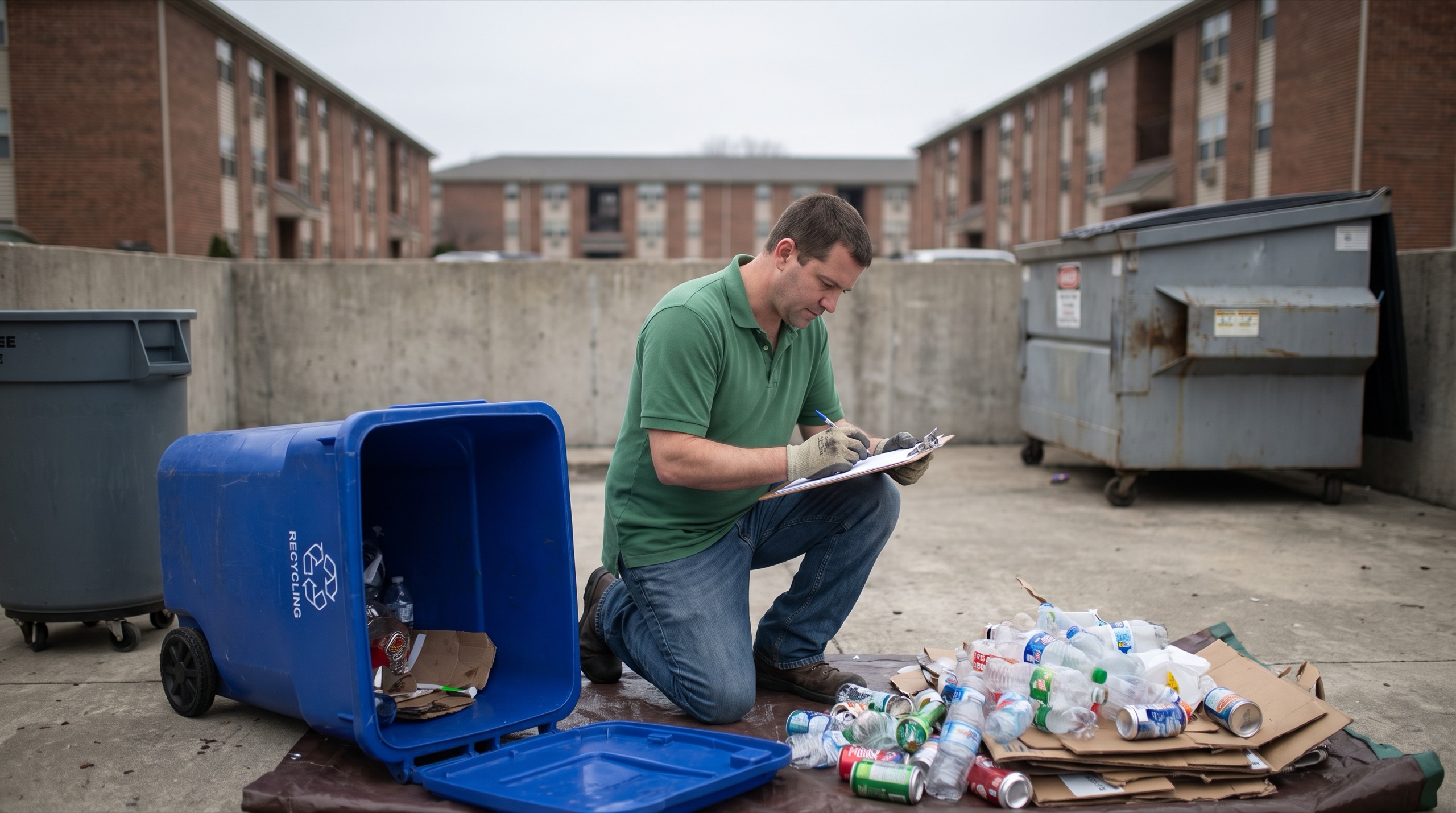
Two numbers and one observation. Measure your diversion rate, which is recycling tonnage as a share of total waste tonnage, and track your contamination events, meaning rejected loads or surcharges. Then walk the waste area unannounced on the busiest setout night of the week, which tells you more than either number alone.
The NAA recommends semi-annual or annual waste audits to assess how operations are performing. An audit doesn’t have to be elaborate. Photograph the contents of each container at a fixed point in the week for four consecutive weeks and you’ll have a defensible picture of what your stream really looks like.
What does a realistic target look like?
Beat the national baseline first. Only 21 percent of residential recyclables in the US are actually recycled, and 76 percent of the material lost is lost at the household level before collection ever happens. A multifamily program that reliably captures cardboard, paper, cans, and bottles from a majority of its units is already outperforming the system average.
Set the second target on contamination rather than volume. A clean stream at a modest capture rate is worth more than a large stream that gets downgraded at the facility, both financially and environmentally. Our guide to valet trash versus traditional dumpsters covers the related question of how container access shapes resident behavior at the enclosure.
Where Doorstep Collection Fits Into a Recycling Program
Does doorstep service help or hurt recycling?
It helps, provided the streams stay clearly separated. The National Apartment Association lists valet service as one of its recommended responses to high-contamination situations, alongside providing in-unit containers for pre-sorting. The mechanism is simple: when a resident’s landfill trash is picked up at the door on a schedule, the pressure to jam a trash bag into whatever container is closest disappears.
The failure mode is worth naming too. If a doorstep program collects trash and recycling in the same bin on the same night with no separation, it produces exactly the contamination it was supposed to prevent. Separate containers, separate nights, or separate compartments are what make it work.
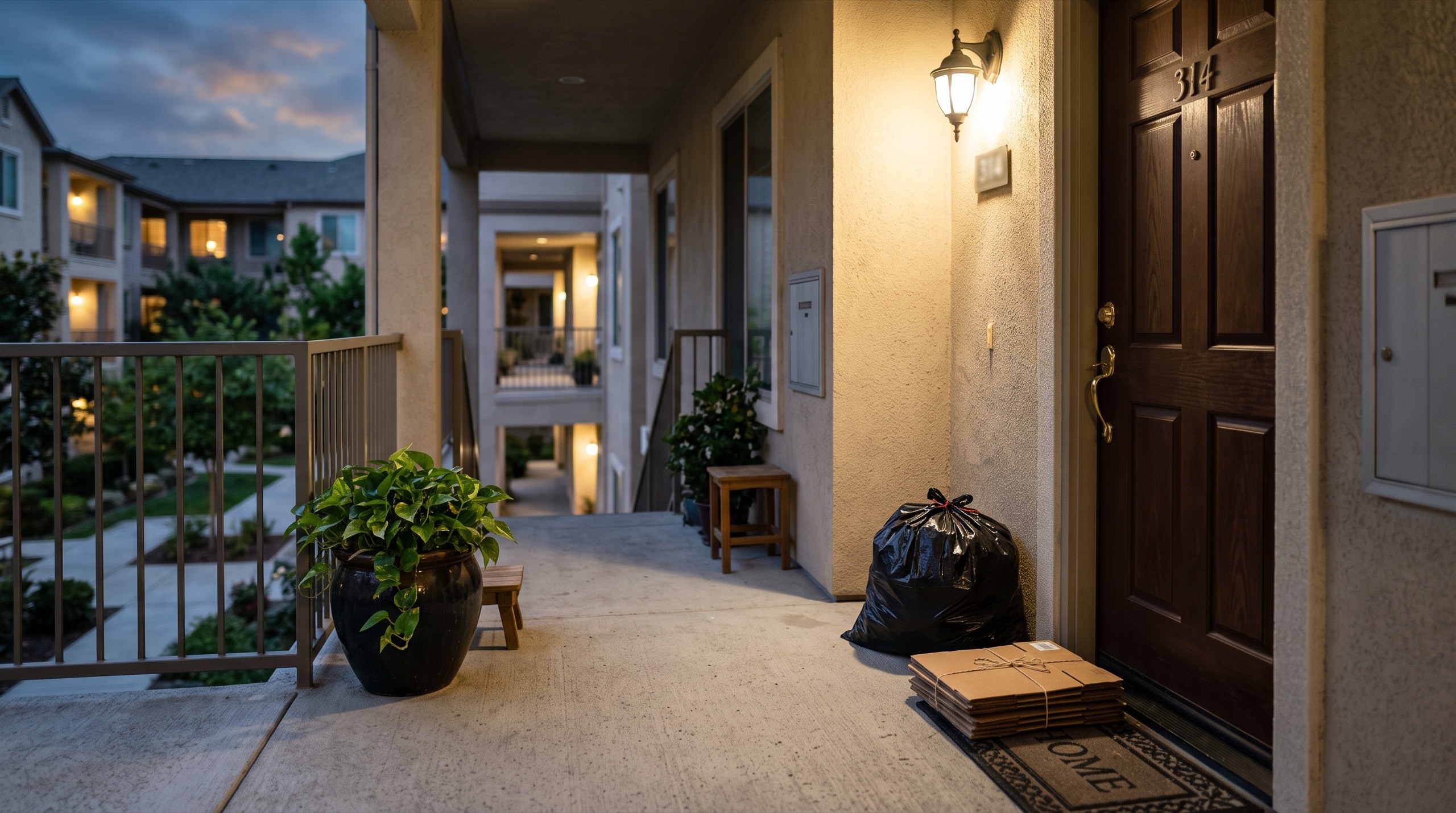
How do the pieces fit together?
Think of it as three layers. Doorstep collection handles the landfill stream reliably so the enclosure stays orderly. Clearly labeled, conveniently placed recycling containers handle the four main material families. Organics, where a state mandate or resident demand justifies it, handles food waste. Each layer removes a reason for material to end up in the wrong place, and our overview of how doorstep waste collection works covers the first layer in detail.
Frequently Asked Questions
The One-Page Recycling Guide to Hand Residents
Most resident education fails because it’s too long. If you take one thing from this guide into your community, make it a single page like the one below, posted at the recycling area and included in every move-in packet.
| Do this | Not that |
|---|---|
| Empty the bag into the cart, keep the bag | Tossing in a tied bag of recyclables |
| Flatten every box before it goes in | Whole boxes that fill a cart on their own |
| Rinse cans, bottles, and jars quickly | Containers with food or liquid still inside |
| Keep paper and cardboard dry | Soaked paper or greasy pizza box bottoms |
| Bottles, cans, paper, cardboard | Plastic bags, foam, electronics, clothing |
| Ask the office when you’re unsure | Guessing and hoping it sorts itself out |
Related Resources
- Is Cardboard Recyclable? is the resident-facing deep dive on the single biggest material in an apartment recycling cart.
- Composting for Apartments covers the organics stream, including the state mandates now reaching multifamily properties.
- What Is Valet Trash? explains how doorstep collection keeps the enclosure orderly and the recycling stream cleaner.
- Valet Trash vs. Traditional Dumpsters compares container access models and their effect on overflow and contamination.
- EPA: Recycling Basics and Benefits is the federal primer on how the recycling process works.
- EPA: Frequent Questions on Recycling answers the contamination and preparation questions residents ask most.
- NAA: Recycling Programs Best Practice is the trade association’s program design guidance for apartment operators.
- The Recycling Partnership: State of Recycling 2024 is the national dataset behind the access and participation figures on this page.
Recycling at Your Community?
If you manage a multifamily community and your recycling program is either missing, contaminated, or quietly costing more than it should, the fix usually starts with placement and reliability rather than a new vendor. Contact Impact Trash Solutions for a free assessment of your waste and recycling setup. Doorstep collection is one of the most dependable ways to keep the enclosure orderly and the recycling stream clean enough to actually get recycled.
This page is reviewed and updated as national recycling access data and multifamily requirements change. Last reviewed: August 2026.