
Multifamily construction hit a 38-year high in 2024, with 608,000 apartment units completed across the country (NAHB, 2025). Every one of those communities needs a waste management plan. And increasingly, that plan includes valet trash.
But how much does it actually cost? If you’ve tried to get a straight answer online, you’ve probably found vague ranges and sales pitches instead of real numbers. This guide breaks down actual valet trash service pricing, the factors that move the needle, and the ROI math that makes it one of the few amenities that pays for itself. If you’re new to what valet trash is and how it works, start there first.
Valet trash costs properties $8-$15 per unit per month, while residents pay $25-$35. That spread creates $13-$27 in net margin per unit. For a 200-unit community, the total annual benefit reaches $79,200 when you factor in net revenue, avoided turnover, and maintenance savings (industry data, 2024-2025). Larger communities get better per-unit rates.
What Does Valet Trash Service Actually Cost?
Property managers typically pay $8 to $15 per unit per month for valet trash service, while residents are charged $25 to $35 monthly (Property Manager Insider, 2024). That gap isn’t accidental. It’s how valet trash becomes a revenue generator instead of just another expense line.
What’s included at that price point? Most providers cover five-night-per-week doorstep collection (Sunday through Thursday), branded containers for each unit, uniformed collection teams, and route management. Some providers include recycling pickup on designated nights at no additional charge. Others bundle it as an add-on.
The property’s cost covers labor, containers, insurance, route logistics, and the provider’s margin. It doesn’t include your existing hauler contract for the dumpsters. Valet trash runs alongside your dumpster service, not instead of it. But it significantly reduces dumpster strain, overflow incidents, and the maintenance headaches that come with them.
Here’s the key number most providers won’t tell you upfront: the net margin. At a property cost of $12 per unit and a resident charge of $35, you’re keeping $23 per unit every month. That’s revenue, not savings.
How Does Pricing Change by Community Size?
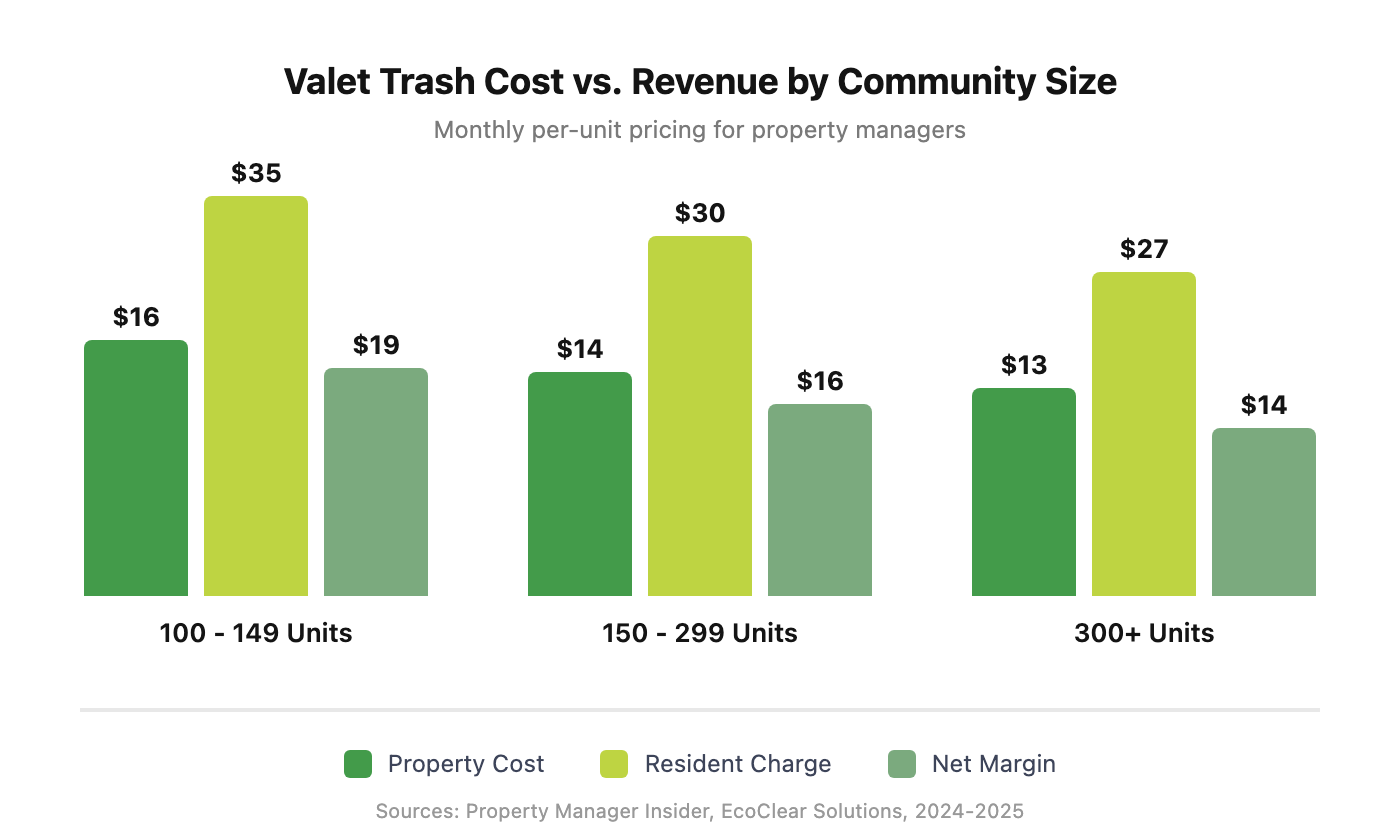
Community size is the single biggest factor in your per-unit rate. A 300-unit garden-style community gets significantly better pricing than a 100-unit property, and the math is straightforward. Larger communities mean more efficient collection routes, lower per-unit labor costs, and better margins for the provider.
Here’s how valet trash service pricing typically breaks down by community size:
| Community Size | Property Cost/Unit | Resident Charge | Net Margin/Unit |
|---|---|---|---|
| 100 – 149 units | $15 – $17 | $30 – $40 | $13 – $23 |
| 150 – 299 units | $13 – $15 | $25 – $35 | $10 – $22 |
| 300+ units | $12 – $14 | $25 – $30 | $11 – $18 |
Notice something? Even though per-unit margins look smaller at 300+ units, the total revenue is dramatically higher. A 300-unit community at $14 net margin per unit generates $50,400 annually. A 120-unit property at $19 net margin generates $27,360. Scale wins.
Don’t have 300 units? Smaller communities can still make valet trash work. The key is negotiating a resident charge that covers your provider cost with room left over. Even $8 per unit in net revenue on a 100-unit property adds $9,600 per year, with zero effort from your team after setup.
What Are the Hidden Costs of Traditional Waste Management?
Before dismissing valet trash as “just another expense,” consider what your current dumpster-only setup actually costs. A traditional waste management system for 100 units runs $1,550 to $3,300 per month when you add up every line item (On The Fly Waste Solutions, 2025). For a deeper look at how these two approaches compare across convenience, cleanliness, and ROI, see our valet trash vs. traditional dumpster comparison.
That breaks down to:
- Dumpster rental: $800-$1,500/month
- Enclosure maintenance: $200-$500/month
- Power washing: $150-$300/month
- Overflow cleanup: $100-$400/month
- Staff time managing complaints: $300-$600/month
And those numbers climb fast. Waste management costs can double within five years without active management. Invoice error rates sit at 9.5%, overflow fees hit $125 to $260 per occurrence, and fuel surcharges add 14% to 45% to your total invoice (SIB Fixed Cost Reduction, 2024). One operator achieved 56.9% savings across 105 properties just by auditing waste invoices.
What’s the Real ROI of Valet Trash?
A 200-unit community charging residents $25 per month with a $12 service cost earns $2,600 in net monthly profit, or $31,200 annually (Ally Waste, 2024). But net service revenue is only part of the picture. When you add maintenance savings, avoided turnover, and rent premium potential, the total annual benefit reaches $79,200.
Here’s how that breaks down for a 200-unit community:
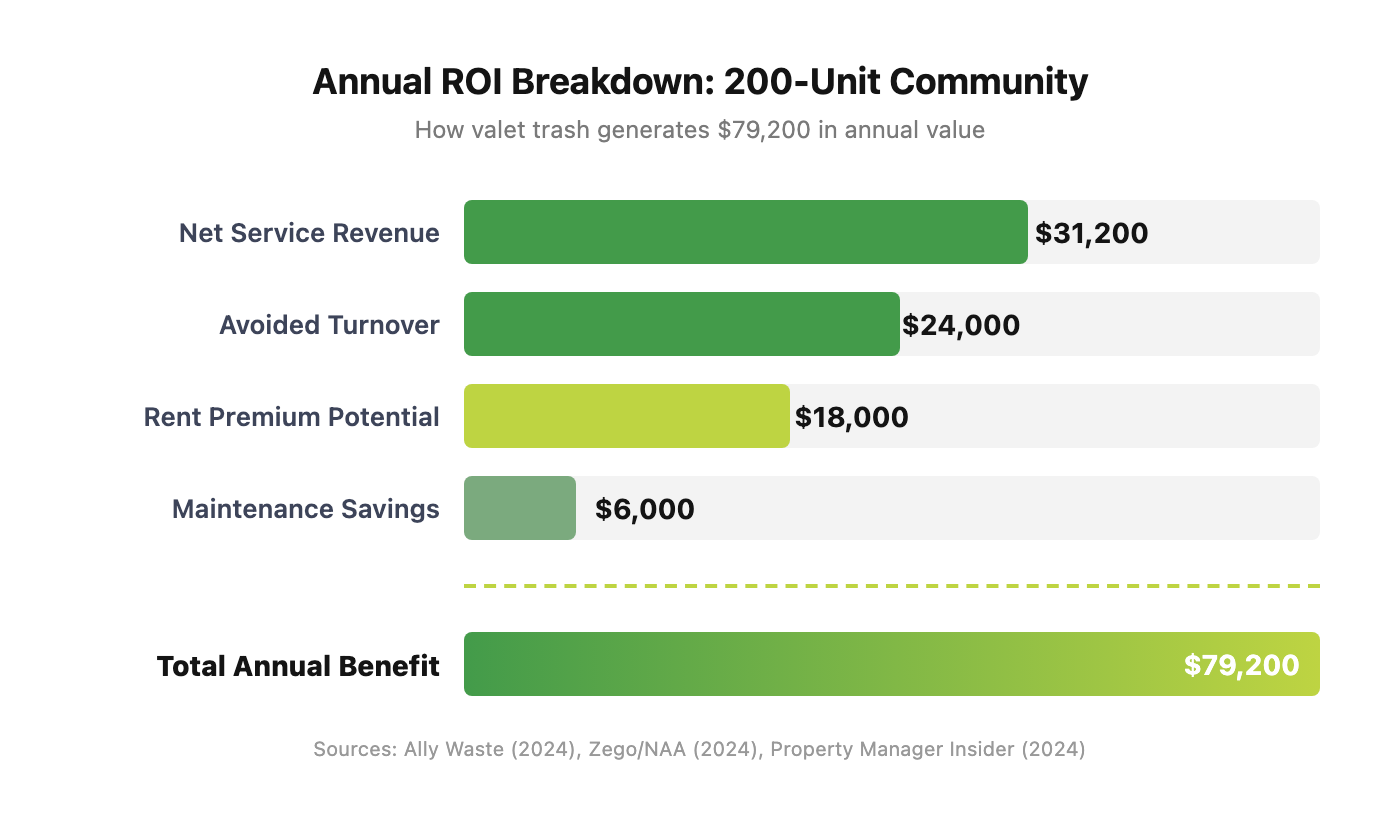
The avoided turnover line deserves attention. Losing a resident costs roughly $4,000 per unit in lost rent, concessions, and turnover maintenance (Multifamily Dive, 2024). That figure has hovered near $4,000 each year since Zego began tracking in 2021. If valet trash helps you retain just 6 additional residents annually, that’s $24,000 in avoided costs.
The property valuation impact is even more compelling. Valet trash directly increases net operating income. At a 5% cap rate, that $79,200 in annual benefit translates to $1.58 million in added property value. At a 4% cap rate, it’s $1.98 million. For an amenity that requires zero capital expenditure from the property, that’s a remarkable return.

How Does Valet Trash Reduce Turnover Costs?
Valet trash reduces turnover by creating a daily-use amenity that becomes part of residents’ routines, making them less likely to leave. Average multifamily retention reached 60% in 2024, the highest since Zego began tracking (Zego, 2024). National renter retention stood at 55.1% in Q1 2025 by a separate measure (LeaseLock, 2025). Both trends point the same direction: properties are getting better at keeping residents, and daily-use amenities play a direct role.
In the 2024 NMHC/Grace Hill Renter Preferences Survey of 172,703 renters across 4,220 communities, residents ranked maintenance (47%), security (46%), and community appearance (34%) as their top renewal priorities (NMHC, 2024). Valet trash directly improves two of those three: maintenance cleanliness and community appearance.
What makes valet trash different from a pool, fitness center, or dog park? Frequency of use. Residents interact with valet trash five to six nights per week. It becomes part of their daily routine. Amenities used daily create stronger emotional attachment to the community than amenities used weekly or monthly. That attachment translates directly to renewal rates.
Consider it from the resident’s perspective: would you move to save $30 per month if it meant losing a service you use every single night? For most residents, the answer is no. Especially when the alternative is hauling trash to a dumpster at 10 PM.
What Factors Affect Your Valet Trash Price?
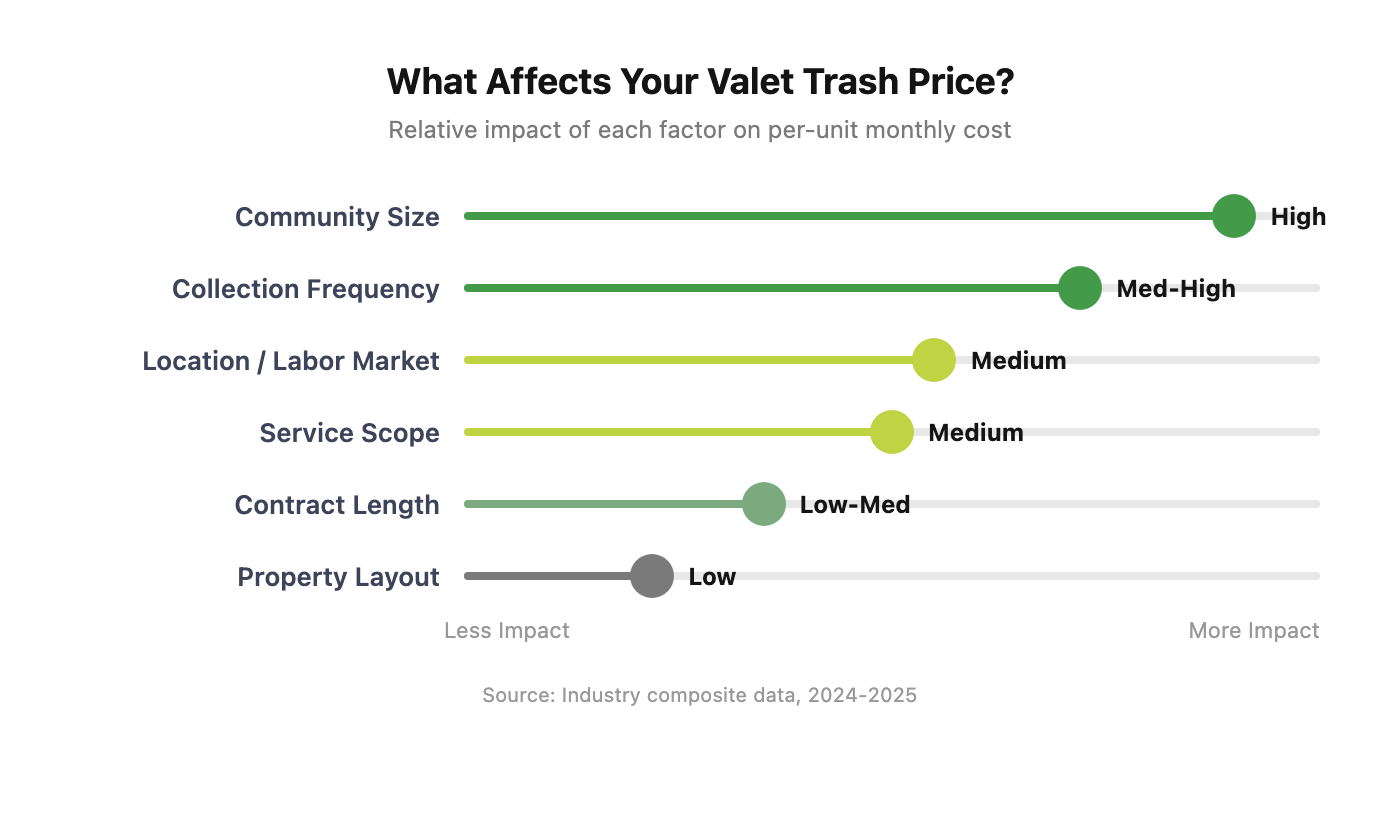
Six factors drive the per-unit cost your property will pay. Community size has the largest impact, but the others matter too, especially when you’re comparing quotes from multiple providers.
Collection Frequency
This is the second-biggest lever. Standard is five nights per week. Adding a sixth night or Saturday service typically adds $1-$2 per unit. Weekend collection is becoming more common at Class A properties where residents expect premium convenience every day of the week.
Location and Labor Market
Collection teams are local hires, so metro areas with higher minimum wages and tighter labor markets (think Nashville, Atlanta, Charlotte) may cost more than smaller markets. Disposal costs also vary by municipality, and some cities charge more for commercial waste hauling permits that affect your provider’s operating costs.
Service Scope and Bundling
Adding recycling collection on designated nights, pet waste station maintenance, or common area cleanup can change the per-unit rate. Bundled services often cost less than contracting each separately. A provider who handles trash, recycling, and pet waste gives you one vendor relationship instead of three.
Contract Length and Property Layout
A two-year commitment may get you $0.50-$1.00 off per unit compared to a one-year term. But don’t lock into a long contract without service-level guarantees. Property layout has modest impact: garden-style communities with spread-out buildings take longer to service than mid-rise buildings with central hallways, but most providers price primarily on unit count.
How Should You Compare Valet Trash Providers on Price?
Compare providers on total cost of service, staffing model, and service-level guarantees, not just the per-unit rate. The cheapest quote isn’t always the best value. The most common reason properties switch valet trash providers isn’t price, it’s reliability. A missed pickup night creates more resident complaints than a $2 price difference ever will.
When evaluating proposals, look beyond the per-unit number:
- What’s the staffing model? Providers with W-2 employees tend to deliver more consistent service than those subcontracting to gig workers.
- What happens when they miss a pickup? Ask for their service-level agreement. Good providers have clear remediation policies.
- Are there hidden fees? Container replacement charges, holiday surcharges, and early termination fees can erode your margin.
- What’s included vs. add-on? One provider’s “all-inclusive” rate at $14 per unit might beat another’s $11 base rate with $4 in add-ons.
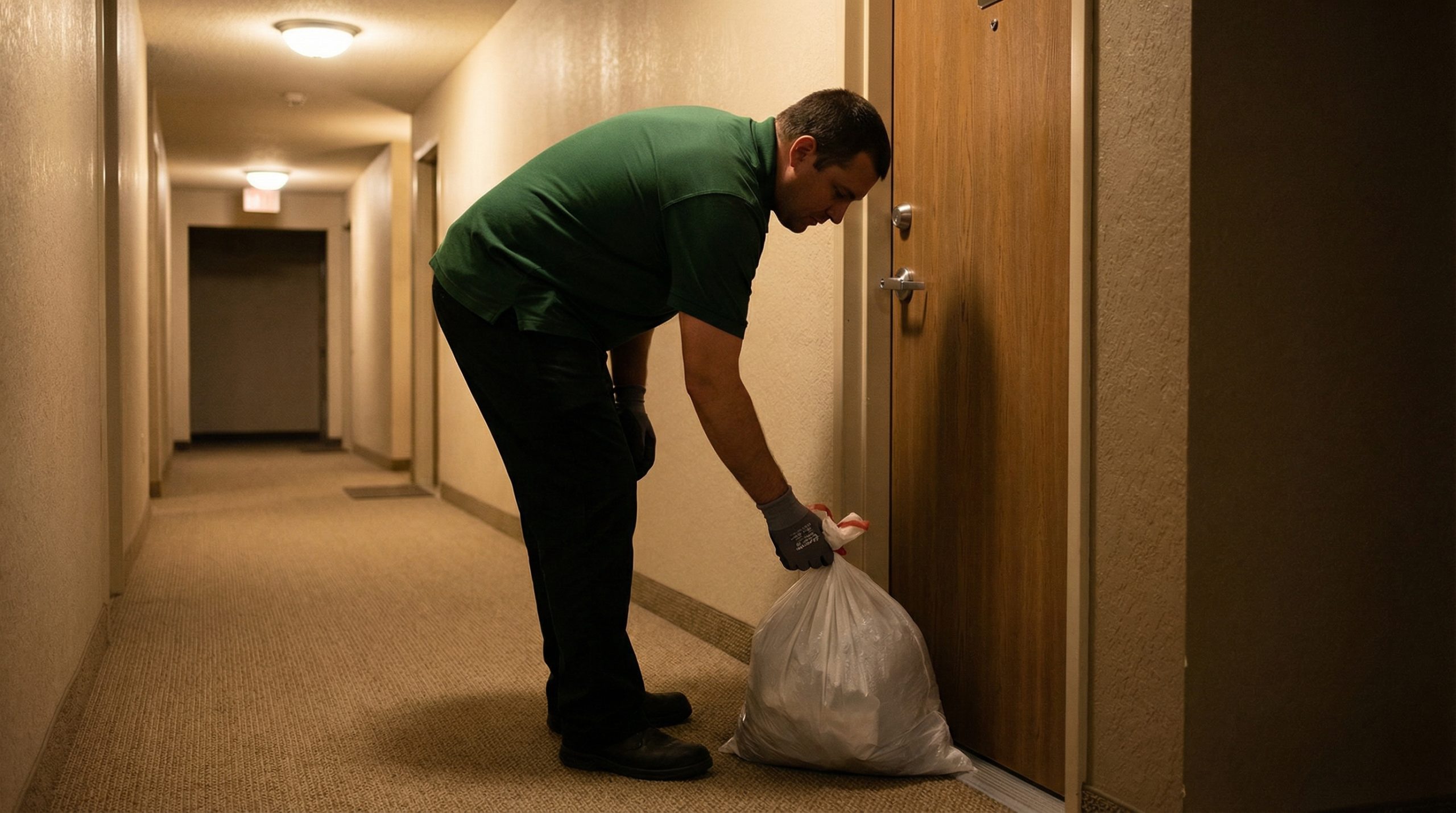
What we’ve learned: Over years of operating across 9 states, the single biggest predictor of a successful valet trash program isn’t price. It’s consistency. Properties that choose a provider based on reliability and communication, rather than whoever submitted the lowest bid, report higher resident satisfaction and fewer management headaches. The $1-$2 per unit difference between providers pales compared to the cost of resident complaints and service disruptions.
Beyond direct cost savings, valet trash reduces recycling contamination at the apartment bin by giving residents a clearly labeled landfill-only stream at the door.
Ready to compare providers? Once you know the budget, our property manager’s guide to choosing a valet trash provider walks through the insurance, contract terms, and red flags to check before you sign.
Frequently Asked Questions
The Bottom Line
Valet trash service pricing works in the property manager’s favor from day one. At $8-$15 per unit in property cost and $25-$35 in resident charges, it generates meaningful net income while improving the metrics that matter most: resident satisfaction, retention, and property appearance.
Key takeaways:
- Property cost: $8-$15 per unit per month. Resident charge: $25-$35. Net margin: $13-$27 per unit.
- A 200-unit community can generate $79,200 in total annual benefit including net revenue, avoided turnover, and maintenance savings
- Community size is the biggest pricing factor, with 300+ unit properties getting the best per-unit rates
- Traditional waste management costs $1,550-$3,300/month per 100 units when you add up every line item
- Choose providers on reliability and service guarantees, not lowest per-unit price
Want to see what valet trash would cost at your community? Impact Trash Solutions provides doorstep collection, recycling, and pet waste management across North Carolina, South Carolina, Georgia, Tennessee, Ohio, Indiana, Kentucky, Missouri, and Michigan. Get a free quote tailored to your property’s size and location.
Related reading: What Is Valet Trash? The Complete Guide for Property Managers | Valet Trash vs. Traditional Dumpsters: Cost, Convenience & ROI Compared