
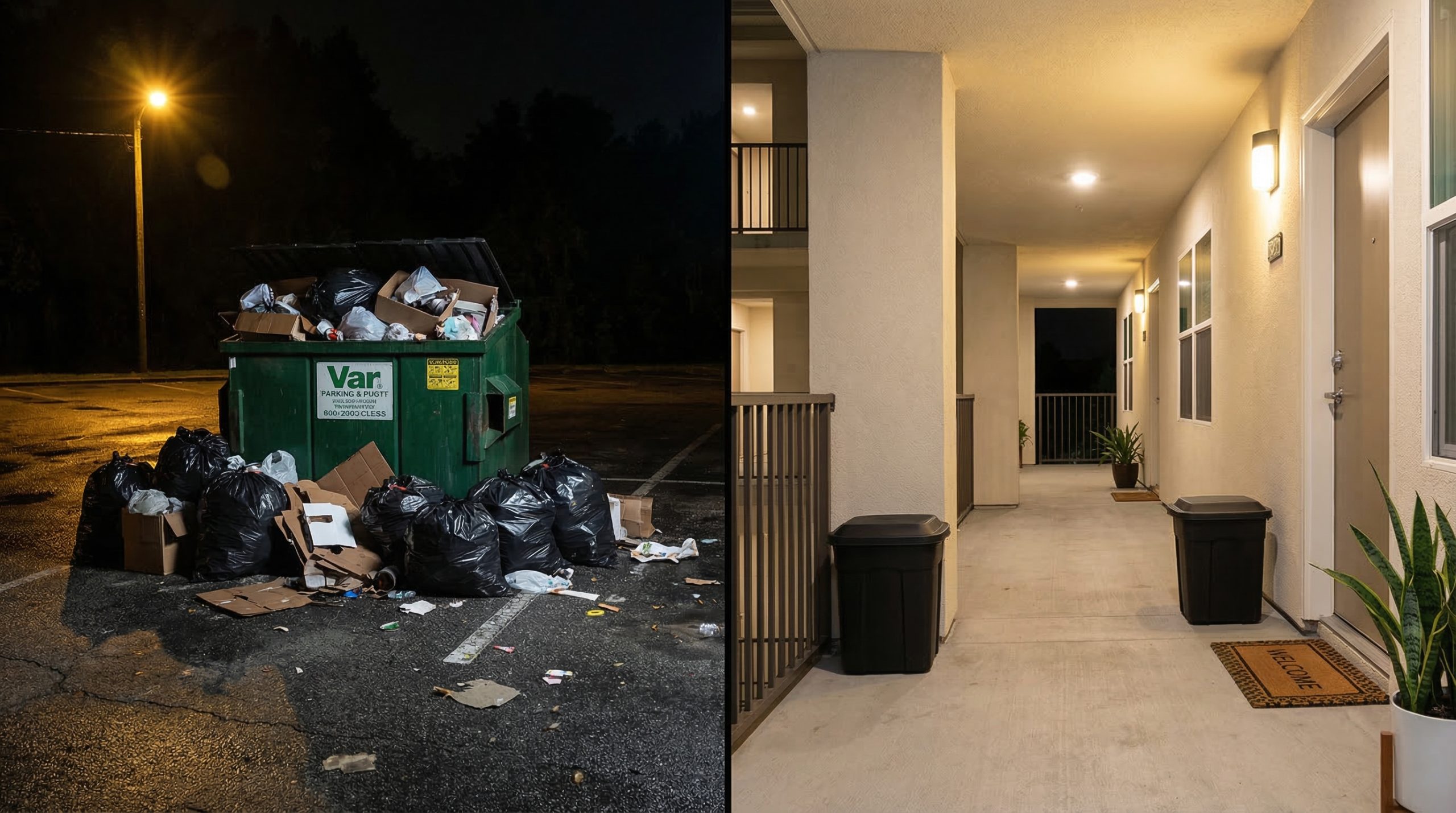
Every apartment community deals with trash. The question isn’t whether you need waste management. It’s which approach gives your property the best return on cleanliness, resident satisfaction, and actual dollars.
Traditional dumpsters have been the default for decades. They work. But “works” and “works well” aren’t the same thing. Valet trash has emerged as the alternative, and over 50% of Class A and B communities have already made the switch (industry estimates, 2025). If you’re still weighing the options, here’s how they actually compare.
Valet trash outperforms traditional dumpsters across every metric that matters to property managers. It generates $23+ per unit monthly in net revenue versus dumpsters’ pure cost, improves resident retention by keeping satisfaction high, and reduces pest control and cleaning expenses by 20-25% (industry data, 2025). The only scenario where dumpsters win is upfront simplicity.
How Does Valet Trash Actually Differ from a Dumpster?
Residents in the 2024 NMHC/Grace Hill survey ranked maintenance (47%) and community appearance (34%) as top priorities when choosing where to live (NMHC, 2024). The difference between these two systems comes down to who does the work and where the trash sits.
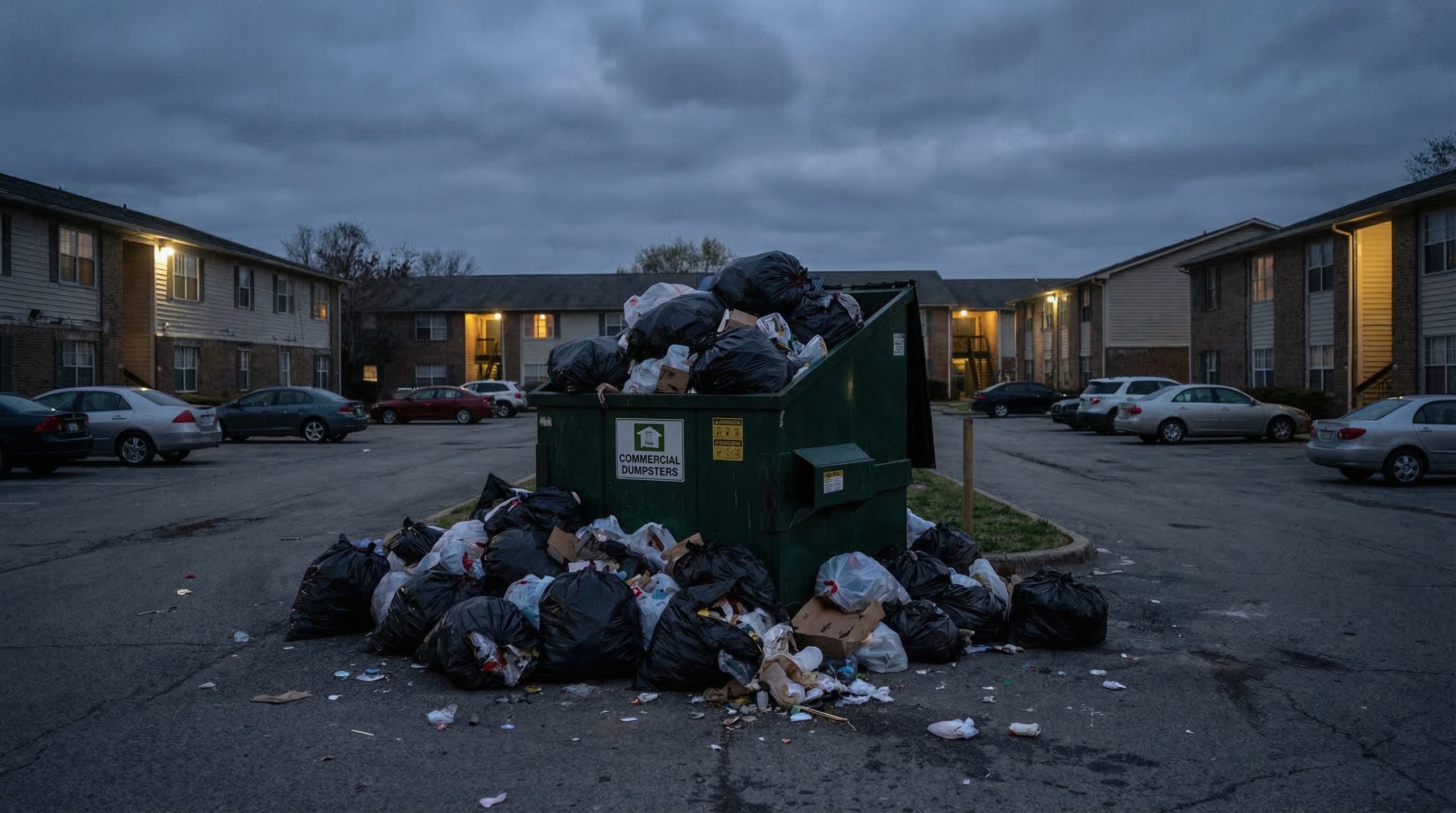
With a traditional dumpster, residents carry their bags to a shared enclosure somewhere on the property. Dumpsters get picked up by a hauler once or twice a week. Between pickups, they fill up. Sometimes they overflow. That’s when the problems start.
With valet trash, a service team walks the property every evening and collects bagged waste from each unit’s doorstep. Residents place their bags in a provided container before the cutoff time, and the team handles everything from there. No trips to the dumpster. No overflow.
Same outcome (trash removed), completely different experience.
Which One Wins on Resident Convenience?
Resident retention hit 55.1% in Q1 2025, the highest on record (NAA, 2025). Convenience amenities that residents use daily are a major factor. And nobody uses a dumpster because they want to.
Think about the resident experience with each option:
The Dumpster Experience
- Carry bags down stairs, through hallways, across the parking lot
- Deal with rain, heat, cold, and darkness
- Navigate overflowing bins and find space to toss bags
- Walk past a dumpster enclosure that smells
The Valet Trash Experience
- Walk to your front door
- Set the bag down
- Done
It’s not close. For families with kids, residents who work late shifts, seniors with mobility limitations, or honestly anyone who’d rather not make a dumpster run at 10 PM, valet trash removes a real daily friction point.

How Do the Costs Actually Compare?
Multifamily waste management costs can increase 15% per year, with total costs doubling over five years (SIB Fixed Cost Reduction, 2024). This is where the comparison gets interesting, because valet trash flips the cost equation entirely.
Dumpsters are a pure expense. You pay the hauler, you pay for extra pickups when bins overflow, you pay for pest control around the enclosure, and you pay for cleaning common areas where bags get left. There’s no revenue offset.
Valet trash is a revenue generator. Properties pay $8-15/unit/month for the service and charge residents $25-50/unit/month. The spread creates net income that didn’t exist before. Here’s what the numbers look like for a 300-unit community:
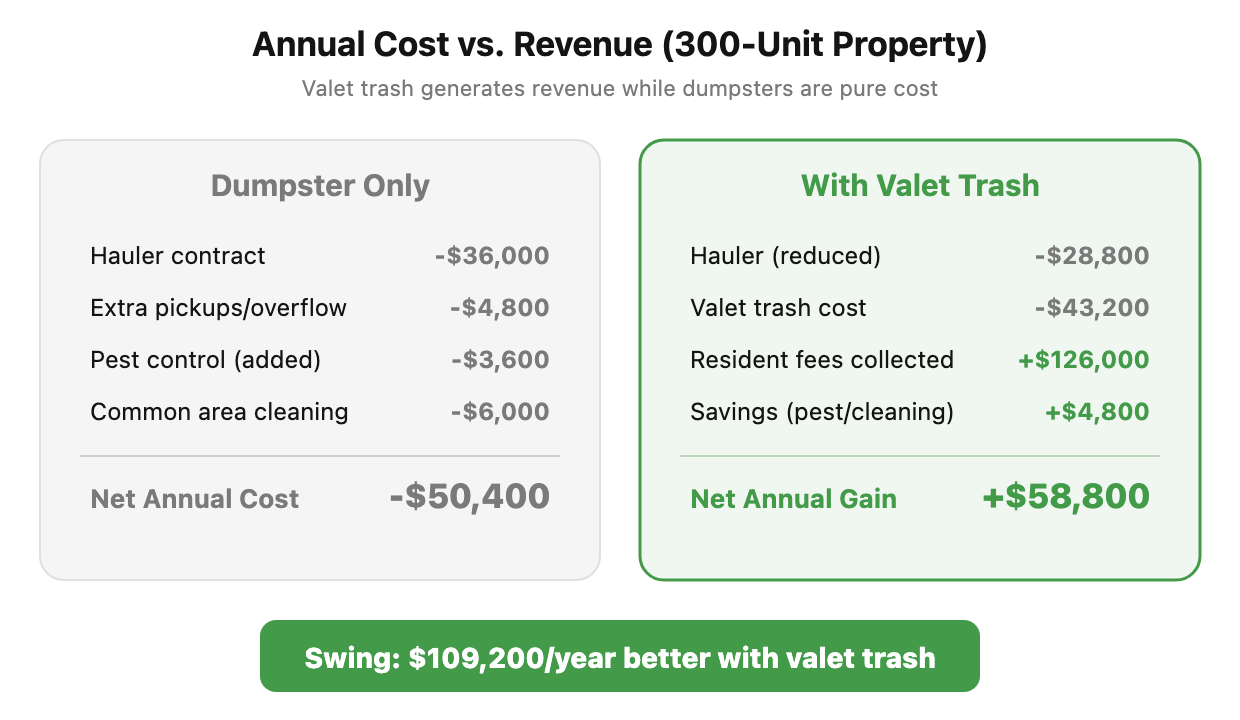
The swing is over $109,000 per year. And that’s conservative. At a 5% cap rate, the $58,800 in annual net valet trash income adds over $1.1 million to property valuation.
Does any other amenity do that?
What About Property Cleanliness and Pest Control?
Properties with valet trash report up to 25% reduction in pest control costs and 15-20% lower common area cleaning expenses (industry estimates, 2024). When residents have a doorstep option, the chain reaction is straightforward.
Fewer trips to the dumpster means fewer bags left in hallways, stairwells, and breezeways. Less overflow means fewer exposed food waste attracting pests. Cleaner dumpster areas (which still exist for bulk items) mean less maintenance time.
Dumpsters, by contrast, create a centralized mess. Every resident who misses the bin, sets bags on the ground because it’s full, or doesn’t tie their bag properly contributes to a visible cleanliness problem. And that mess attracts roaches, rats, and complaints.
How Does Each Option Affect Resident Retention?
Losing a resident costs approximately $4,000 per unit in lost rent, concessions, and turnover maintenance (NAA/Zego, 2024). Retention is where valet trash creates a compounding advantage over dumpsters.
Nobody renews a lease because the dumpster is convenient. But residents do renew because they like their daily routine, and doorstep trash collection becomes part of that routine fast. It’s used 5-6 times per week, making it the most-used amenity at most properties. Pools get seasonal use. Fitness centers serve maybe 15-20% of residents. Valet trash serves everyone, every day.
When a resident considers moving to a community without valet trash, they’re giving up something they use daily. That’s a retention advantage dumpsters can’t match.
What About Safety and Accessibility?
This is the comparison nobody talks about, but it matters. A lot. Dumpster enclosures are typically located at the edges of parking lots, away from buildings. Getting there means walking through poorly lit areas, often at night, carrying a heavy bag.
For a 25-year-old in good health, that’s annoying. For a 75-year-old with a hip replacement, it’s a fall risk. For a single parent carrying a toddler and a trash bag, it’s a juggling act. For anyone after dark in a community that’s had car break-ins, it feels unsafe.
Valet trash eliminates all of that. The furthest anyone walks is their front door. That’s not a luxury. For some residents, it’s the difference between managing independently and needing help with a basic daily task.
How Does Each Option Impact Property Valuation?
Multifamily property values are driven by Net Operating Income (NOI). Every dollar of NOI gets multiplied by the market cap rate to determine value. This is where the math gets dramatic.
A dumpster contributes nothing to NOI. It’s a line item on the expense side. More pickups, more cost. Overflow cleanup, more cost. Pest control around the enclosure, more cost. Every year those costs go up, and your NOI goes down.
Valet trash does the opposite. At $23/unit net revenue on 300 units, you’re adding $82,800 to annual NOI. At common cap rates:
- 5% cap rate: $82,800 / 0.05 = $1,656,000 added to property value
- 5.5% cap rate: $82,800 / 0.055 = $1,505,455 added to property value
- 6% cap rate: $82,800 / 0.06 = $1,380,000 added to property value
That’s $1.3 to $1.6 million in added property value from a service that costs the property nothing out of pocket. The resident fee covers the vendor cost and then some. Show that math to an asset manager and the conversation shifts from “should we add valet trash?” to “why haven’t we already?”
What Do Residents Actually Say?
Satisfaction surveys and online reviews tell the same story. Residents who’ve experienced valet trash don’t want to go back to dumpsters. The language they use is telling: “convenient,” “love it,” “best amenity,” “can’t imagine living without it.”
Compare that to what residents say about dumpsters: “overflowing,” “smells,” “far away,” “gross,” “unsafe at night.” Nobody has ever left a positive review about a dumpster.
This matters for leasing too. When prospective residents tour a community and see clean breezeways with small, neat containers outside doors, it signals a well-managed property. When they walk past an overflowing dumpster enclosure with bags on the ground, it signals the opposite. First impressions are hard to undo.
The Full Head-to-Head Comparison
Here’s how valet trash and traditional dumpsters stack up across the metrics that matter most to property managers:
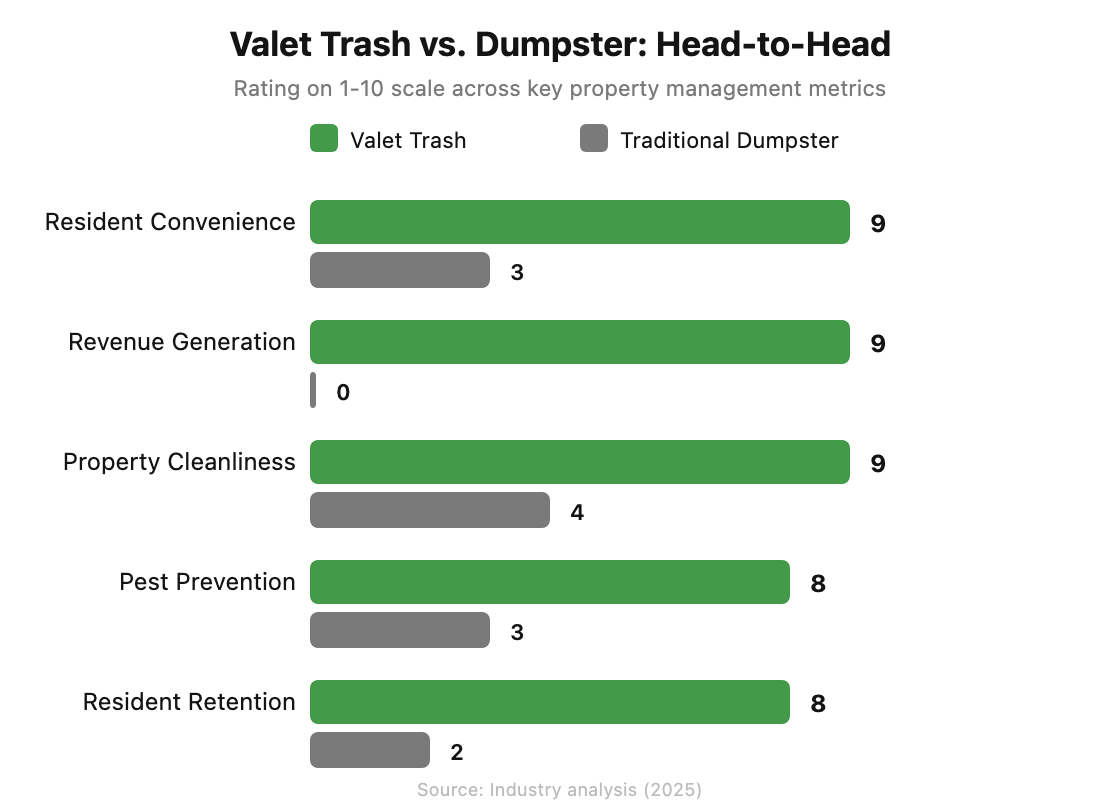
Dumpsters win on exactly one thing: they’re already there. There’s no implementation, no resident communication, no vendor relationship to manage. If “zero effort” is the goal, dumpsters deliver.
But if the goal is better operations, happier residents, and more revenue, valet trash wins every other category.
When Does Each Option Make More Sense?
Stick with dumpsters only if your community has fewer than 50 units (harder to achieve route efficiency), the property layout makes doorstep access impractical, or your market’s rent levels don’t support an amenity fee.
Add valet trash if you have 100+ units, compete in a market where neighboring properties offer it, want to generate ancillary revenue, or need to improve curb appeal and resident satisfaction. For most Class A and B communities, the question isn’t whether valet trash makes sense. It’s why you haven’t added it yet.
Ready to see the numbers for your property? Our step-by-step implementation guide walks through the full rollout process from vendor selection to first pickup night.
Frequently Asked Questions
The Bottom Line
Valet trash isn’t just a nicer version of a dumpster. It’s a fundamentally different approach that turns a cost center into a revenue stream. The numbers speak for themselves:
- Revenue: $23+ per unit/month net (vs. $0 from dumpsters)
- Cleanliness: 20-25% reduction in pest and cleaning costs
- Retention: The most-used daily amenity, driving renewal rates
- Valuation: $1M+ added property value for a 300-unit community
Impact Trash Solutions provides valet trash, recycling collection, and pet waste management across 9 states. Request a free quote to see what valet trash would look like at your community.