

The U.S. rental market hit 22.4 million households in 2025 (NAA, 2026), and property managers are under pressure to differentiate. Valet trash has become one of the fastest-growing amenities in multifamily housing, with adoption growing at roughly 8% annually across Class A and B communities.
But here’s the thing: the service itself is simple. The rollout is where most properties stumble. A poorly communicated launch creates resident frustration, staff confusion, and complaints that take months to recover from.
This guide breaks the implementation process into three phases with clear timelines, so you can go from vendor selection to first pickup in 60 days or less.
Valet trash implementation takes 30-60 days across three phases: Foundation (vendor vetting, contracts, financials), Launch (staff training, resident communication, go-live), and Follow-Through (ongoing management, optimization). Properties typically charge residents $25-50/unit/month against a $8-15/unit cost, generating $82,800+ annually for a 300-unit community (industry data, 2025).
Why Are So Many Properties Adding Valet Trash?
Over 50% of Class A and B apartment communities now offer doorstep trash collection, up from roughly 30% five years ago (industry estimates, 2025). The reason isn’t complicated. Valet trash is one of the few amenities that generates net revenue from day one while simultaneously improving resident satisfaction and property cleanliness.
In the 2024 NMHC/Grace Hill Renter Preferences Survey of 172,703 renters, 47% ranked maintenance as their top priority and 34% ranked community appearance (NMHC, 2024). Valet trash directly improves both. And unlike pools or fitness centers that cost money to maintain, doorstep collection pays for itself.
So what does it take to get it right?
What Does the Implementation Timeline Look Like?
Most successful rollouts take 30 to 60 days from signed contract to first pickup night. Rushing this creates problems. Taking too long lets momentum die. The sweet spot is a structured 60-day plan with clear milestones.
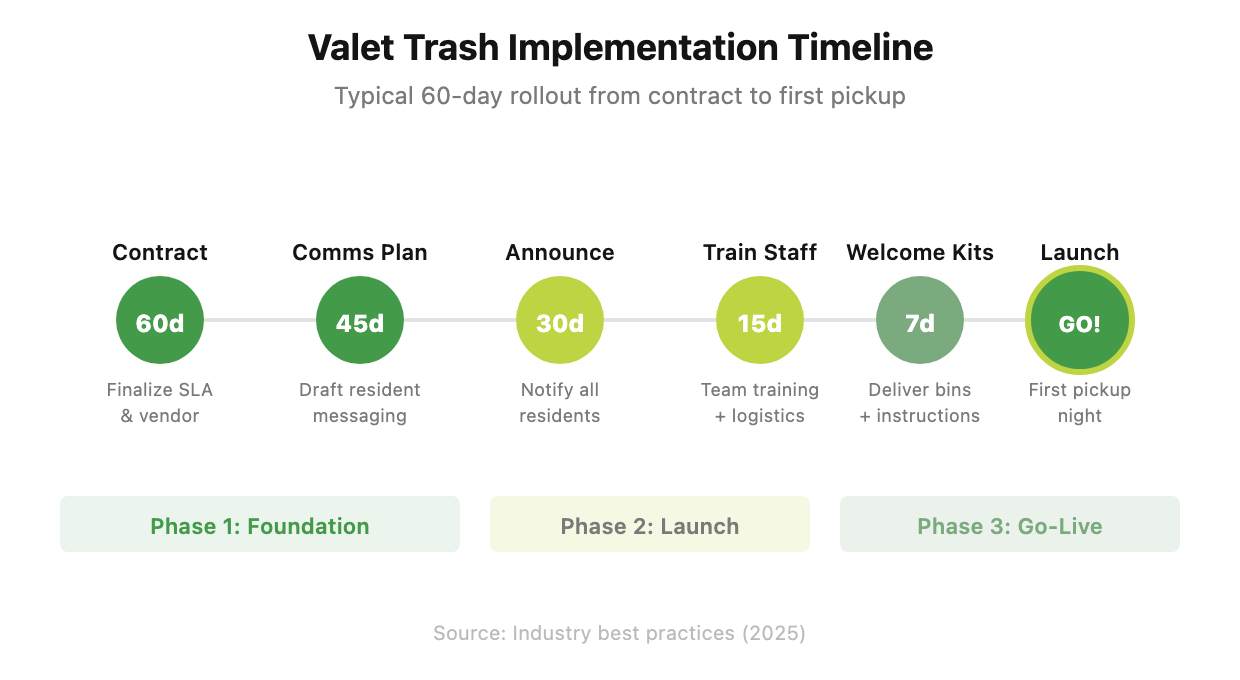
Here’s how each phase breaks down.
Phase 1: How Do You Build the Right Foundation?
Resident retention hit 55.1% in Q1 2025, the highest rate on record (NAA, 2025). Amenities that residents use daily play a direct role in that number. Getting valet trash right starts with picking the right partner and structuring the deal correctly.
How Do You Choose the Right Vendor?
Your valet trash provider becomes an extension of your on-site team. They’re on your property every night, interacting with residents through the quality of their work. A bad vendor creates more problems than no service at all.
Before you start comparing proposals, define your property’s specific needs:
- Unit count and layout. Garden-style communities with scattered buildings have different route requirements than a single high-rise tower.
- Service scope. Do you want trash only, or trash plus recycling? What about pet waste management?
- Collection frequency. Five nights per week is standard. Some properties want six.
When you’re vetting providers, these questions separate the serious operators from the rest:
- Are your collectors W-2 employees or 1099 contractors? (W-2 typically means better training and reliability.)
- What technology do you use for service verification? Look for GPS tracking and photo documentation.
- Can you provide references from similar-sized properties in my market?
- What’s your protocol for missed pickups? How quickly do you resolve them?
How Should You Structure the Financials?
Properties typically pay $8 to $15 per unit per month for valet trash service, while charging residents $25 to $50 per month. That spread creates meaningful net revenue with minimal effort from the management team.
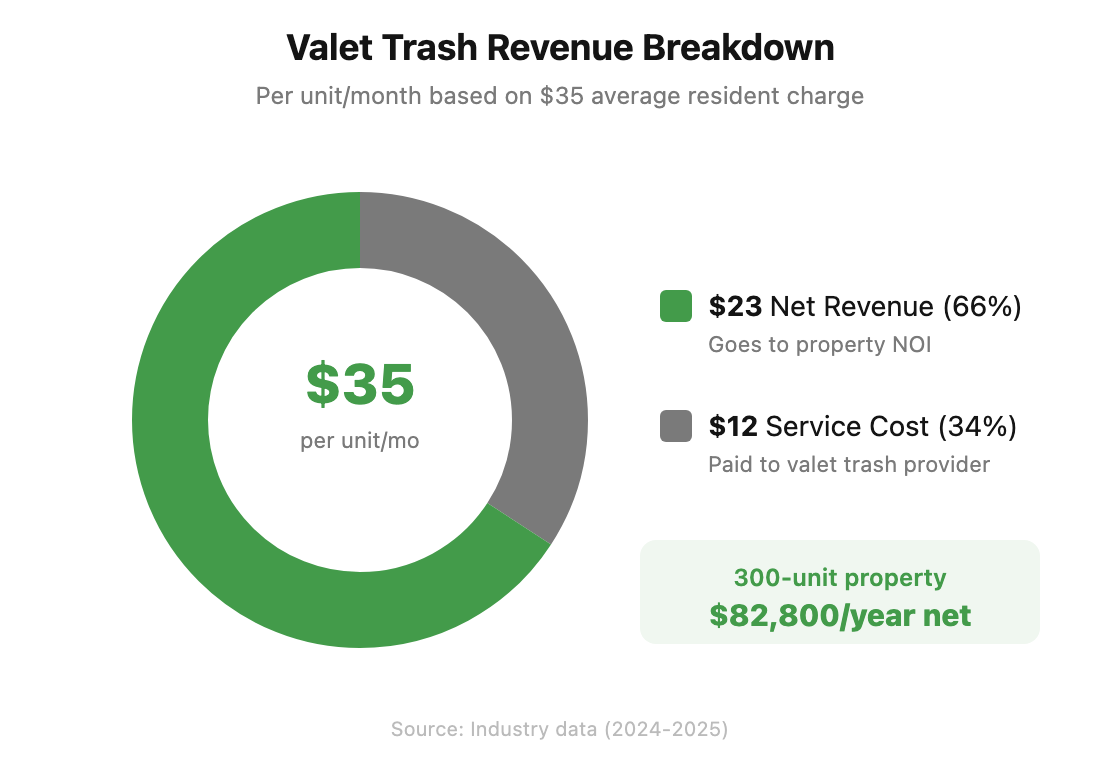
For a 300-unit community at an average net gain of $23 per unit, that’s $82,800 in additional annual revenue. At a 5% cap rate, that adds over $1.6 million to the property’s valuation.
When structuring the resident fee, be transparent. Frame it as a required community amenity, similar to water or pest control. Properties that try to slip it in without clear communication get pushback. Properties that lead with the value don’t.
What Should the Contract Cover?
Your service level agreement needs to be specific. Vague contracts lead to finger-pointing when something goes wrong. Make sure it addresses:
- Pickup schedule and windows. Exact days, start time, completion deadline.
- Missed pickup protocol. Response time, resident notification, service credits.
- Holiday schedule. Define every holiday with no collection, published in advance.
- Liability. Who covers property damage? What about resident complaints?
- Reporting. Monthly service reports with pickup completion data.
- Exit terms. Reasonable contract length (12-24 months) with performance-based outs.
Phase 2: How Do You Launch Without Resident Backlash?
Losing a resident costs roughly $4,000 per unit in lost rent, concessions, and turnover maintenance (NAA/Zego, 2024). A botched valet trash launch can trigger exactly that kind of turnover if residents feel blindsided by a new fee. Communication is everything in this phase.
How Do You Get Your Staff Ready?
Your leasing team, maintenance crew, and office staff will all get questions from residents. If they don’t know the answers, it creates confusion and erodes confidence in the program.
Hold a mandatory training session with your vendor before the launch. Cover:
- Program rules (what’s accepted, what isn’t, pickup times)
- How to handle the top 5 resident questions
- The escalation path for service issues
- Gate access, bin storage locations, and route logistics

What’s the Best Way to Tell Residents?
Lead with benefits, not logistics. Your first message should make residents think “that’s convenient,” not “that’s another fee.” The details come second.
Effective messaging focuses on three points:
- Convenience. No more hauling bags to the dumpster at night or in bad weather.
- Cleanliness. Fewer overflowing dumpsters and cleaner common areas for everyone.
- Safety. No more walks to dimly-lit dumpster enclosures after dark.
Use every channel: email, community portal, flyers in common areas, and at least one in-person Q&A. People who feel informed rarely complain. People who feel surprised almost always do.
What Should Go-Live Week Look Like?
The first week sets the tone. Get it right and residents settle into the routine quickly. Get it wrong and you’ll spend months recovering.
Best practices for launch week:
- Vendor supervisor on-site. Your provider should have a supervisor walking the property the first 1-3 nights, not just the regular collection team.
- Morning walk-throughs. Walk the property the morning after each of the first few pickups. Check for missed bags, messy breezeways, or containers left in wrong spots.
- Active feedback collection. Ask residents directly how the first few nights went. This shows you’re invested and catches issues early.
- Quick response to complaints. Any issue in week one should be resolved within hours, not days.

Phase 3: How Do You Keep Service Quality High Long-Term?
Multifamily waste management costs can increase 15% per year (SIB Fixed Cost Reduction, 2024). Valet trash offsets those rising costs, but only if the service stays consistent. The follow-through phase is where many programs quietly decline.
What Should Ongoing Management Include?
Set up three recurring practices:
- Quarterly business reviews (QBRs). Meet with your vendor every quarter. Review pickup completion rates, complaint trends, and any staffing changes. This keeps accountability high.
- Resident rule reinforcement. Send friendly reminders 2-3 times per year about pickup times, acceptable items, and how to report issues. New move-ins especially need this.
- Issue tracking. Designate one channel (portal, email, or phone) for residents to report service problems. Track patterns. If the same building gets missed every Tuesday, that’s a route problem your vendor needs to fix.
How Do You Handle Common Challenges?
Three problems come up most often after launch:
Resident pushback on fees. This almost always happens because communication was unclear upfront. If it surfaces, respond by reinforcing the value (convenience, cleanliness, safety) rather than getting defensive about the cost. Frame it alongside other community amenities.
Logistical issues. Complex layouts, breezeway clutter, and holiday schedule confusion are the most common operational headaches. Work with your vendor to create a detailed service map. Communicate the holiday schedule at least two weeks in advance, every time.
Service inconsistency. If quality slips, address it immediately through the SLA. Use your vendor’s service verification data (GPS logs, photos) to identify specific gaps rather than making general complaints. Specifics get results.
Frequently Asked Questions
Ready to Start?
Impact Trash Solutions provides valet trash implementation, recycling collection, and pet waste management across North Carolina, South Carolina, Georgia, Tennessee, Ohio, Indiana, Kentucky, Missouri, and Michigan. We’ve rolled out programs at communities of every size, from 80-unit garden-style to 500+ unit high-rises.
Request a free quote and we’ll put together a custom implementation plan for your property. Most communities go from first conversation to first pickup in under 60 days.