

Most property managers shop for valet trash the same way: collect three quotes, compare the per-unit price, and sign with the cheapest one. It feels efficient. It’s also how communities end up with bags rotting in breezeways on a Saturday and a leasing office fielding angry calls on Monday.
The price difference between providers is usually a few dollars per unit. The difference between a reliable operator and a problem one shows up in missed pickups, resident complaints, and the hours your team spends managing a vendor that should be invisible. One of those costs far more than the other.
This guide is deliberately vendor-neutral. It covers what to verify, what belongs in the contract, the red flags to walk away from, and the exact questions to ask before you sign, so you can evaluate any valet trash company, including ours, on the things that actually predict good service.
Choosing a valet trash provider comes down to five things: proof of insurance and a clean safety record, a contract with real service guarantees, a stable W-2 collection crew, transparent per-unit pricing, and references from properties like yours. Refuse collection is the fifth most dangerous occupation in the U.S. (BLS, 2024), so a provider’s workers’ comp and liability coverage protect your property, not just theirs. The cheapest bid rarely wins. Reliability does, because one missed-pickup complaint costs more in resident goodwill than a few dollars per unit ever saves.
What Should Property Managers Look for in a Valet Trash Company?
The best valet trash provider is the one residents forget exists, because nothing ever goes wrong. Getting there comes down to five evaluation criteria: insurance and safety record, contract terms with enforceable guarantees, crew stability, pricing transparency, and verifiable references. Every other detail is downstream of these five.
Why these five? Because they’re the factors that separate a service you never think about from one that generates a complaint thread in your resident portal. A glossy sales deck doesn’t predict reliability. A certificate of insurance, a defined missed-pickup remedy, and three references from properties your size do.
If you’re still deciding whether the service itself makes sense for your community, start with our overview of what valet trash is and how it works, then come back here to evaluate providers. This page assumes you already know you want the amenity and now need to pick the right company to run it.
One more framing before the criteria: think about total cost, not sticker price. A provider that’s two dollars per unit cheaper but misses pickups twice a month can cost you a turned lease, a string of one-star reviews, and hours of staff time chasing fixes. Across a 200-unit community, a single avoidable move-out can wipe out a full year of that supposed savings. Price the risk, not just the rate.
The rest of this guide walks through each criterion in order, starting with the one nobody else talks about and the one most likely to cost you if you get it wrong: insurance and safety.
Why Does a Provider’s Insurance and Safety Record Matter So Much?
In 2024, refuse and recyclable material collectors had a fatal injury rate of 37.4 per 100,000 full-time workers, the fifth-highest of any occupation in the country (SWANA, citing the BLS 2024 Census of Fatal Occupational Injuries). This is genuinely hazardous work, and it happens on your property, at night, around residents and moving vehicles.
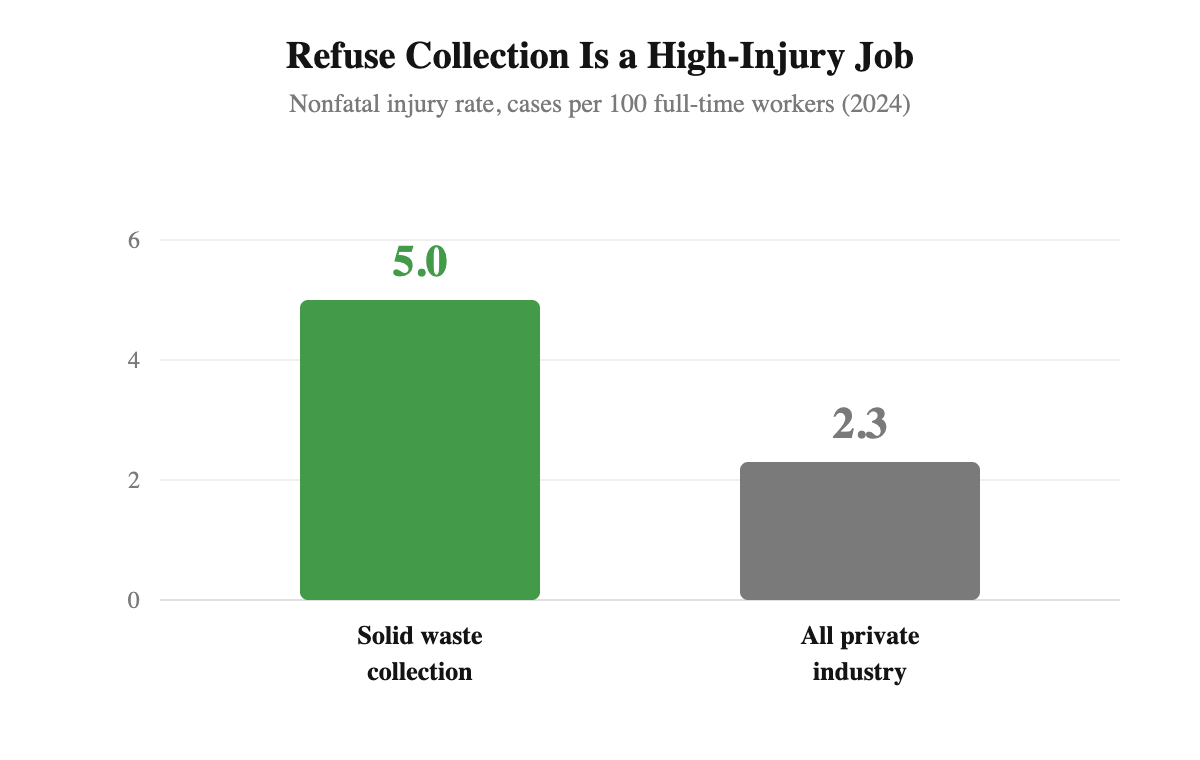
The nonfatal numbers tell the same story. In 2024, solid waste collection workers were injured at a rate of 5.0 cases per 100 full-time workers, up from 4.3 the year before and more than double the 2.3 rate for all private industry (Waste Dive, citing BLS, 2024). When a crew works that kind of risk profile on your grounds, the question isn’t whether someone will eventually get hurt. It’s who pays when they do.
Here’s the part that catches owners off guard. If a provider is underinsured and a collector is hurt on your property, or a resident slips on a spilled bag in a stairwell the crew was responsible for, that exposure can flow back to the property’s general liability policy. You don’t just want a vendor who carries coverage. You want proof.
Ask every provider for a current certificate of insurance and read the limits, not just the checkmarks. At minimum, verify workers’ compensation, general liability, and commercial auto liability for the collection vehicles. Then ask them to name your ownership entity as an additional insured and to include an indemnification clause in the contract. A reputable operator hands this over without flinching.
Being named as an additional insured is the clause that actually protects you. It means the provider’s general liability policy extends to claims arising from their work on your property, so a crew-related injury or incident is defended by their insurer first, not yours. Without it, you can carry your own coverage and still end up footing the bill. It costs the provider nothing to add, and whether they offer it willingly tells you how seriously they take the relationship.
What Belongs in a Valet Trash Contract?
The sales call is where a provider makes promises. The contract is where those promises become enforceable, or quietly disappear. Roughly 110 property managers search “valet trash contract” every month (DataForSEO, 2026), and the ones who read the fine print before signing avoid the traps that the ones who don’t discover a year later.
Two clauses cause the most pain. The first is the evergreen auto-renewal, a term that silently rolls into another multi-year commitment unless you cancel inside a narrow window you’ve long forgotten. The second is the missing service-level agreement: a contract that never defines what happens when the crew misses a pickup, which means the answer is nothing. Here are the terms worth negotiating before you sign. For what the service itself should cost, see our valet trash pricing guide.
| Contract Clause | What to Negotiate For |
|---|---|
| Term length | A 1-year initial term, or a longer term with a performance-based exit. Avoid 3-year locks with no out. |
| Auto-renewal | A clear, reasonable cancellation window (30 to 60 days), not an evergreen clause that renews silently for years. |
| Missed-pickup remedy (SLA) | A defined consequence: a service credit per missed night and a cure period before you can terminate for repeated failures. |
| Price-escalation cap | A stated annual increase ceiling (for example, capped at CPI or a fixed percentage) so renewals don’t bring surprises. |
| Termination for cause | The right to exit without penalty if service standards aren’t met after written notice. |
| Insurance and indemnification | Your entity named as additional insured, with indemnification and current COI attached as an exhibit. |
| Equipment ownership | Clarity on who owns the resident containers if you part ways, so a switch doesn’t strand residents without bins. |
One practical tip: ask for the service agreement and the certificate of insurance as separate documents up front, and request that the COI be attached as a labeled exhibit. Reputable providers share a redline-friendly contract and expect a few edits. The ones who present a rigid, take-it-or-leave-it document with no room to add a service-level clause are telling you exactly how flexible they’ll be once the ink is dry.
None of this requires a lawyer to spot, though it’s worth one to finalize. Read the term, find the renewal language, look for the word “credit” near “missed,” and confirm the COI is attached. If the contract is silent on what happens when service slips, that silence is the deal you’re actually signing.
National Chain or Local Provider: Which Is Right for Your Community?
Neither model is universally better, and any provider claiming otherwise is selling. The right answer depends on your portfolio size, your geography, and how much account-level attention you need. A 12-property regional portfolio and a single 80-unit community have genuinely different priorities here.
National chains like Valet Living, Trash Butler, and Ally Waste bring broad multi-state coverage, standardized processes, and resident-facing apps. The trade-off is that a smaller community can become a minor account, routed through a call center rather than a named local manager. Regional operators tend to offer denser routes in their core markets, a direct line to someone who knows your property, and more flexibility on scheduling, though their footprint is narrower.

There’s also a portfolio angle worth weighing. If you manage properties spread across several states, a national provider can simplify vendor management with one contract and one point of billing across markets. If your communities cluster in a single region, a local operator with dense routes there often delivers tighter service and faster problem-solving. Match the provider to your actual footprint, not to whichever brand name is most familiar.
The factor that matters more than national-versus-local is the staffing model underneath it. Does the company collect with its own W-2 employees, or does it subcontract to gig workers who change week to week? Consistent crews learn your property’s layout, your problem buildings, and your schedule. Rotating crews relearn it every night, badly.
Impact Trash Solutions sits in the regional-operator category: we run our own crews across nine states, which is why we lean on the points above. That’s not a reason to pick us. It’s a reason to ask any provider you’re considering exactly how they staff routes, because that single answer predicts more about your day-to-day experience than the logo on the truck.
How Does Your Choice of Provider Affect Resident Retention and NOI?
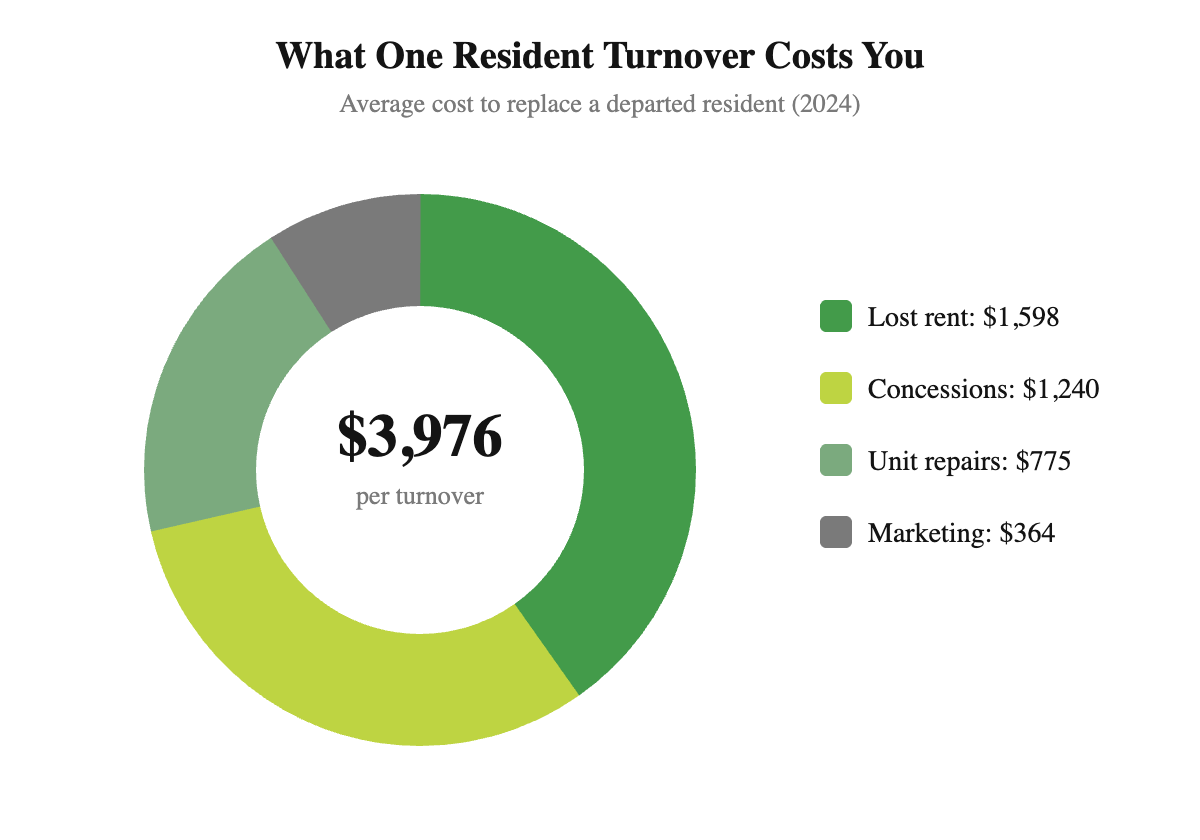
In 2024, replacing a single departed resident cost an average of $3,976 and took 17.6 months to recoup, broken into lost rent, concessions, repairs, and marketing (Multifamily Dive, citing Zego). Valet trash is supposed to protect that revenue by being an amenity residents use every single day. A bad provider does the opposite.
Resident retention is working in your favor right now. In 2024, 59% of residents said they planned to renew, the highest rate since the survey began in 2021, and 75% of property managers expected retention to keep improving (NAA, citing Zego). A reliable doorstep amenity reinforces that. A provider that leaves bags sitting in hallways undermines it.
Residents notice trash more than you might think. The 2024 NMHC and Grace Hill renter survey of 172,703 renters found that people are particularly sensitive to how their neighbors and their community handle noise, pets, and trash (Multifamily Dive, citing NMHC/Grace Hill, 2024). When valet trash runs well, it’s invisible. When it fails, it becomes the thing residents mention in their reviews.
The math compounds in the wrong direction when service is poor. Every resident who leaves over a preventable annoyance, like bags piling up near their door, takes that $3,976 with them, along with the goodwill of neighbors who watched it happen and now wonder what else management lets slide. A provider you chose carefully protects renewals you’ve already earned. A provider you chose on price alone can quietly chip away at them, one complaint at a time.
So is valet trash worth it? Yes, when the provider is reliable. The return lives entirely in retention and cleanliness, and a weak operator erases both. For the full breakdown of pricing and the revenue math, see our guide to what valet trash costs per unit, and our comparison of how doorstep service stacks up against traditional dumpsters.
What Questions Should You Ask Before Signing?
The fastest way to separate a reliable provider from a risky one is to ask direct questions and listen for hesitation. A strong operator answers each of these without a sales detour. Here are the questions that matter, roughly in order of how much they predict your day-to-day experience.
- Are your collectors W-2 employees or subcontractors? Consistent, employed crews are the single best predictor of reliable service.
- Can I see your current certificate of insurance and the coverage limits? Workers’ comp, general liability, and auto, with my entity as additional insured.
- What is your guaranteed pickup window, and what happens when you miss it? Listen for a defined service credit, not a vague apology.
- Who is my single point of contact, and how fast do you respond? You want a name, not a ticket queue.
- Can you provide three references from properties my size in my market? Then actually call them and ask about missed pickups.
- How do you handle holidays, severe weather, and surge weeks? Move-in season and the post-holiday box flood test every provider.
- Do you provide digital proof of service? Route tracking or photo confirmation turns “did they come?” into a fact.
- What is the contract term, and how does renewal work? Confirm the cancellation window before you sign, not after.
- Who owns the containers if we part ways? A clean exit shouldn’t strand residents without bins.
If a provider answers the first three questions clearly, you’re likely dealing with a real operator. If they get evasive about insurance, staffing, or what happens when they miss a night, you’ve learned what you needed to know before signing anything.
What Are the Red Flags of a Bad Valet Trash Provider?
Most service problems are visible before you sign, if you know what to look for. The warning signs cluster around the same five criteria from the top of this guide. Here’s how the good and the risky tend to sort out.
| Green Flags | Red Flags |
|---|---|
| A stable, named crew assigned to your property | A different, anonymous crew every week |
| Certificate of insurance provided on request | “We’re covered, don’t worry about it” |
| A defined missed-pickup remedy in writing | No service-level guarantee at all |
| A 1-year term or a performance-based exit | A 3-year evergreen lock with no out |
| A clear per-unit price and what it includes | Vague bundling and “it depends” pricing |
| References from properties your size, nearby | No references, or only out-of-market ones |
How Do You Switch Valet Trash Providers Without Disrupting Residents?
If you already have a provider and you’ve recognized a few red flags, switching is routine and low-risk when you sequence it correctly. Residents shouldn’t notice anything except that the service got better. The whole transition usually fits inside 30 to 45 days.
Start by reading your current contract’s notice and termination terms, since that window dictates your timeline. Then line up the new provider’s first night to overlap the old provider’s last, so there’s never a gap. Communicate the change to residents about a week out with a simple notice: same service, new company, nothing they need to do. Finally, confirm container logistics, whether the new provider supplies bins or the old ones stay.
Timing is the only real risk, and it’s straightforward to manage. Give your outgoing provider written notice inside their required window, then schedule the incoming crew’s first collection for the same night the old one stops. Residents keep setting bags out exactly as they always have. If containers are changing, the new provider can distribute fresh ones during the overlap, so no door is ever left without a bin and nobody has to think about the handoff.
For the full step-by-step rollout, including resident communication templates and the launch checklist, see our step-by-step rollout playbook. A clean switch is mostly about timing and a one-paragraph heads-up to residents.
Frequently Asked Questions
The Bottom Line
Choosing a valet trash provider isn’t really about finding the lowest per-unit price. It’s about finding the operator who will run quietly in the background for years without becoming your problem. That comes down to proof of insurance, a contract that enforces reliability, a stable crew, transparent pricing, and references you actually call.
Key takeaways:
- Refuse collection is the 5th most dangerous U.S. occupation, so verify workers’ comp, general liability, and auto coverage, and get named as additional insured.
- The contract is where reliability is enforced. Watch for evergreen auto-renewals and demand a defined missed-pickup remedy.
- Ask whether collectors are W-2 employees or rotating subcontractors. Crew stability predicts service quality more than the company’s size.
- A bad provider erodes the retention benefit valet trash is meant to create, and replacing one resident averages $3,976.
- The cheapest bid rarely wins. Reliability does. Switching providers is low-risk when you sequence the transition correctly.
Impact Trash Solutions provides valet trash, recycling collection, and pet waste management with our own crews across North Carolina, South Carolina, Georgia, Tennessee, Ohio, Indiana, Kentucky, Missouri, and Michigan. Request a free quote and we’ll send our certificate of insurance and references along with your per-unit pricing, so you can evaluate us against every criterion in this guide.
Last updated: June 2026. We refresh this guide as new BLS safety data and multifamily retention figures are released.