
The United States hit an all-time high of 22.4 million rental households in 2025 (NAA, 2026). With that growth comes a simple problem: trash. Traditional dumpsters create eyesores, attract pests, and force residents to haul bags across parking lots at night.
Valet trash solves this by bringing collection directly to each resident’s door. Over 50% of Class A and Class B apartment communities now offer it, and adoption is growing at 8% annually (industry estimates, 2024). For property managers, it’s become one of the highest-ROI amenities available.
This guide covers everything you need to know: how valet trash works, what it costs, the benefits for your community, and how to evaluate providers.
Valet trash is a doorstep waste collection service for apartment communities. Residents place bags outside their doors on scheduled evenings, and a service team collects them. It costs properties $8-15/unit/month but generates $25-50/unit in resident charges, creating net revenue of $10-42/unit monthly (industry data, 2025). It also improves retention and reduces common area maintenance.
What Does Valet Trash Mean?
Over 480 people search “what is valet trash” every month, and the answer is straightforward. Valet trash is a doorstep waste and recycling collection service designed for multifamily residential communities. Instead of residents walking to a shared dumpster, a uniformed service team picks up bagged trash directly from each unit’s doorstep on a set schedule.
Think of it like room service for your garbage. The word “valet” means the same thing here as it does with valet parking: someone handles the task for you.
How Is It Different from Traditional Dumpster Service?
Traditional apartment waste management relies on shared dumpsters or compactors placed in parking areas or enclosures. Residents are responsible for carrying their own trash to these locations, regardless of weather, time of day, or physical ability.
Valet trash flips this model. The service comes to the resident, not the other way around. This creates a cleaner property, fewer pest issues, and a premium amenity that residents actually use every day.
The 4-Step Valet Trash Process
- Bag it. Residents place household waste in standard trash bags (typically 13-gallon kitchen bags).
- Set it out. Bags go in a provided collection container outside the front door before the scheduled pickup time (usually 8 PM).
- Collection. The valet trash team walks the property each evening, collecting bags from every participating unit.
- Container return. Empty containers are placed back at each door, ready for the next pickup.
How Does Valet Trash Work for Apartments?
Renter retention reached 55.1% in Q1 2025, up 1.6 percentage points from 2023 (NAA, 2025). Amenities that residents use daily, like valet trash, play a direct role in that retention. Here’s how the service operates in practice.
Pickup Schedule
Most valet trash providers collect 5 to 6 nights per week, Sunday through Thursday or Monday through Friday. Residents place their bags outside by a posted cutoff time, typically between 7 PM and 9 PM. Collection teams finish their routes by midnight.
Some providers offer recycling pickup on designated nights (for example, Tuesday and Thursday for recycling, all other nights for trash). This keeps the process simple and predictable for residents.
What Can Residents Set Out?
Standard household waste in bags that fit the provided container. Most providers accept:
- Kitchen waste and food scraps (bagged)
- Recyclables (paper, cardboard, plastic, glass, aluminum) on designated nights
- Small household items that fit in a standard bag
Providers don’t accept hazardous materials, loose liquids, construction debris, or oversized items. These still go to the property’s dumpster or require a separate bulk pickup.
Who Handles What?
The property manager selects the provider, communicates the program to residents, and includes the service fee in the lease or as a utility charge. The valet trash provider supplies containers, hires and manages the collection team, handles route logistics, and deals with any service issues directly.
Residents just bag their trash and set it out. That’s it.
How Much Does Valet Trash Cost?
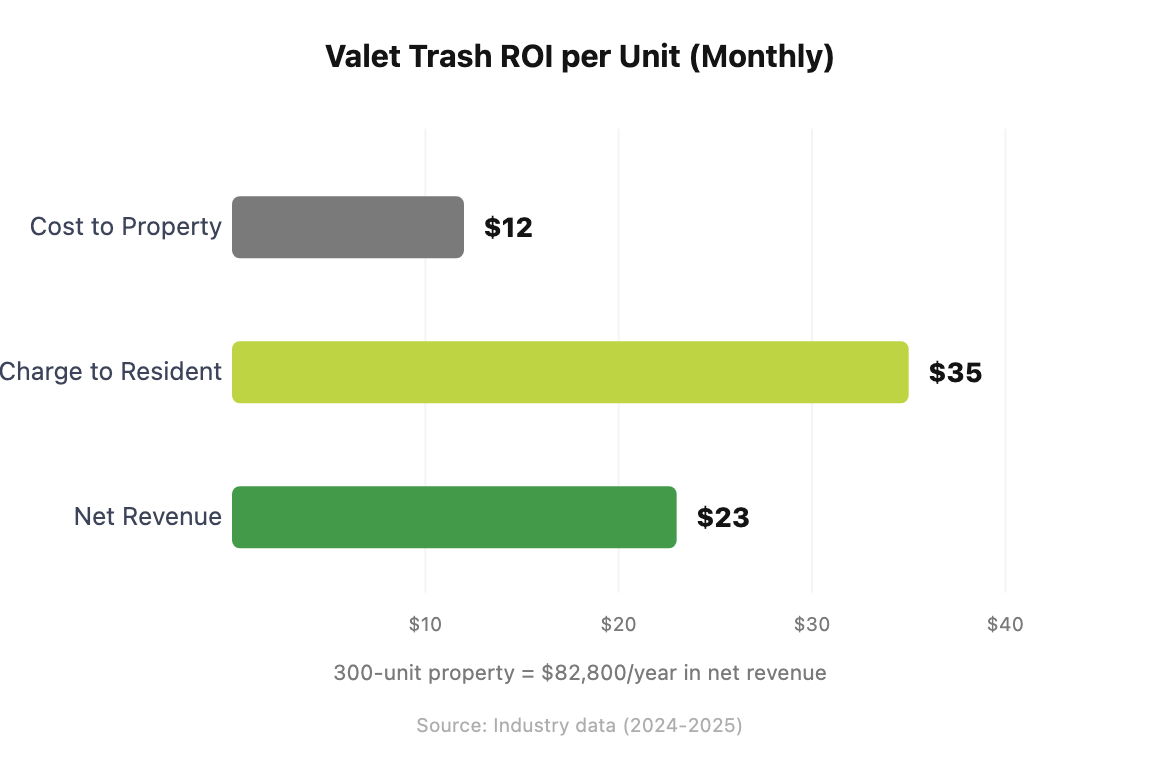
Properties typically pay $8 to $15 per unit per month for valet trash service, while residents are charged $25 to $50 per month (industry data, 2025). That spread creates meaningful net revenue for the property, often $10 to $42 per unit each month.
For a 300-unit community, the math adds up fast. At an average net gain of $23 per unit, that’s $82,800 in additional annual revenue, with minimal effort from the property management team.
What Affects Pricing?
Several factors influence what you’ll pay:
- Community size. Larger properties (300+ units) get better per-unit rates due to route efficiency.
- Collection frequency. Five nights per week is standard. Adding weekends or recycling nights may increase cost.
- Location. Labor markets and disposal costs vary by state and metro area.
- Service scope. Bundling recycling collection, pet waste management, or amenity maintenance can affect the overall package price.
Most providers offer a free quote based on your property’s unit count and location. For a detailed breakdown by community size, ROI calculations, and what factors affect your rate, see our valet trash pricing guide.
What Are the Benefits of Valet Trash for Property Managers?
Residents rank maintenance (47%), security (46%), and community appearance (34%) as their top priorities when evaluating where they live (NMHC/Grace Hill 2024 Renter Preferences Survey). Valet trash directly improves two of those three: maintenance cleanliness and community appearance.
But the benefits go beyond resident perception. Here’s what the numbers show.
Revenue Generation
As the pricing section above shows, valet trash creates a net-positive revenue stream. Unlike amenities that cost money to maintain (pools, fitness centers, dog parks), valet trash pays for itself and generates profit from day one.
Retention and Turnover Reduction
Losing a resident costs roughly $4,000 per unit in lost rent, concessions, and turnover maintenance (NAA/Zego, 2024). Properties with valet trash report higher satisfaction scores and stronger renewal rates. When residents use an amenity every single day, it becomes part of their routine and a reason to stay.
Operational Savings
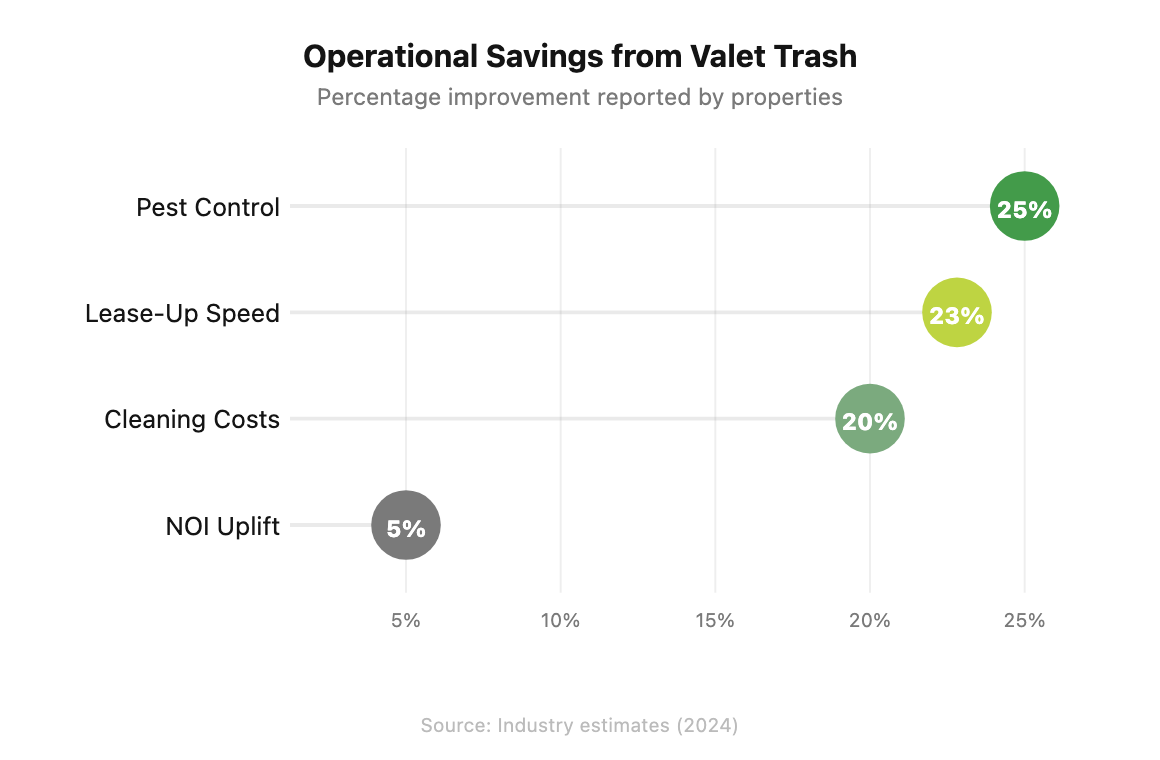
Properties with valet trash see measurable reductions across multiple cost centers. Less trash in common areas means less cleaning. Fewer overflowing dumpsters means fewer pest calls. Cleaner grounds mean faster lease-ups with prospective residents.
Why Do Residents Love Valet Trash?
In the NMHC/Grace Hill 2024 Renter Preferences Survey of 172,703 renters across 4,220 communities, 85% said they enjoy living in their community (NMHC, 2024). Satisfaction tracks directly with amenities residents use regularly, and valet trash is used 5-6 times per week.
Here’s why residents consistently rate it as a top amenity once they’ve experienced it.
Convenience
No more carrying bags down stairs, through hallways, across parking lots, and into a dumpster enclosure. Residents walk to their front door, set the bag down, and they’re done. For families with young children, people working late shifts, or anyone who simply doesn’t want to make the trip, the convenience is immediate and tangible.
Cleaner Community
When every resident has a doorstep option, fewer people leave bags in hallways, stairwells, or breezeway corners. Dumpster areas stay cleaner because they’re handling less volume. The whole property looks and smells better, which matters to the 34% of renters who rank community appearance as a top priority.
Safety and Accessibility
Walking to a dumpster at 10 PM isn’t appealing for anyone. For seniors, residents with mobility limitations, or people in communities where the dumpster is far from their building, valet trash removes a real barrier. This is especially important for senior living communities, where a late-night walk to the dumpster can be a fall risk.
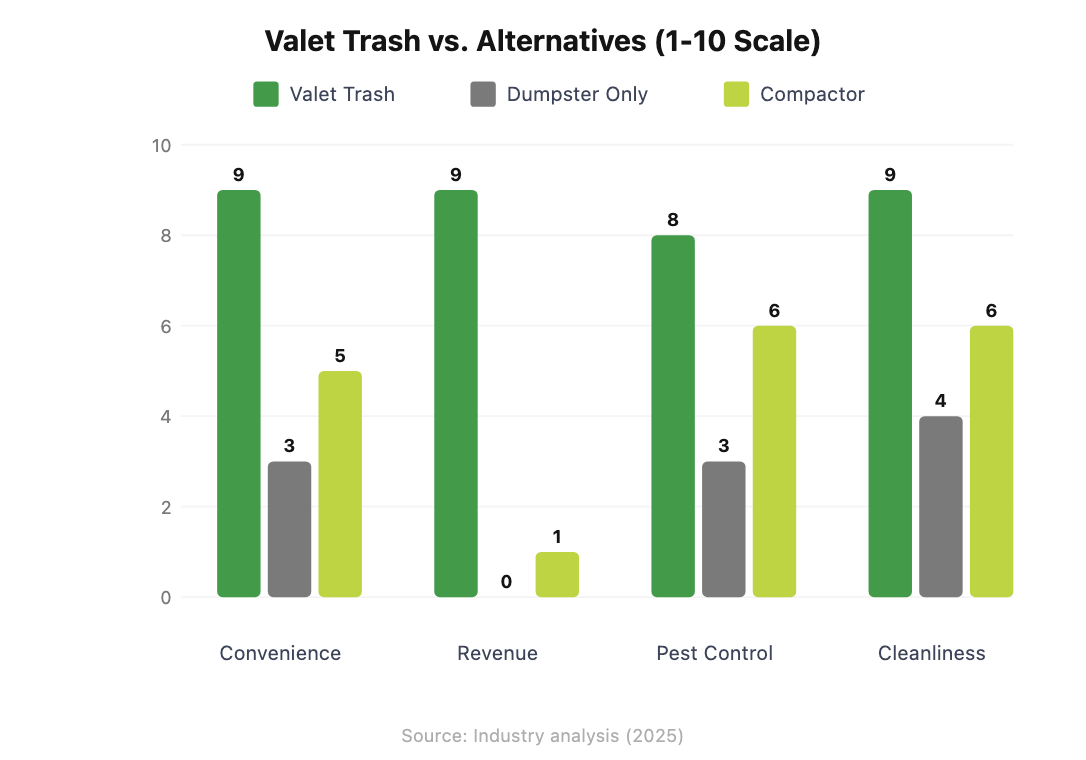
Is Valet Trash Worth It? Comparing Costs and Alternatives
Waste management costs for multifamily properties can increase 15% per year, and total costs can double over five years (SIB Fixed Cost Reduction, 2024). Valet trash doesn’t replace your hauler contract, but it does reduce the strain on dumpsters and create a revenue stream that offsets rising waste costs.
How does it compare to the alternatives?
When Does Valet Trash Make the Most Sense?
Valet trash delivers the strongest ROI for communities with:
- 100+ units. Route efficiency improves with scale, and per-unit costs drop.
- Class A or B properties. Residents at these communities expect premium amenities and are accustomed to paying for convenience.
- Scattered dumpster locations. If residents have to walk more than 100 yards to a dumpster, valet trash solves a real pain point.
- Competitive markets. In metros where neighboring communities already offer valet trash, not having it becomes a disadvantage.
Smaller communities (50-100 units) can still benefit, but the economics depend on local labor costs and the provider’s minimum pricing.
How Does Valet Trash Work for Senior Living Communities?
The U.S. senior living market reached $72.11 billion in 2025 and is projected to grow to $101.86 billion by 2031 at a 5.92% CAGR (Mordor Intelligence, 2025). Senior housing occupancy hit 90% in Q4 2025, the highest since 2017. With the oldest baby boomers turning 80 in 2026, demand for senior-friendly services is accelerating.
Valet trash is uniquely suited to senior communities for three reasons.
Mobility and Independence
For residents with limited mobility, walking to a dumpster isn’t just inconvenient. It can be dangerous. Uneven pavement, poor lighting, and the physical effort of lifting a bag into a dumpster create real fall risks. Doorstep collection removes this entirely. Residents maintain their independence without the physical demands.

Daily Check-In
A valet trash team visits every door, every night. If a container hasn’t been set out for several consecutive days, it can be a signal to the community manager. While it’s not a formal wellness check, it adds a layer of routine observation that families appreciate.
Cleaner Common Areas
Senior communities prioritize cleanliness and curb appeal for prospective residents and their families. Valet trash keeps hallways, breezeways, and parking areas free of bags and odors, maintaining the polished environment these communities need.
What About Recycling and Pet Waste Services?
The most recent EPA national study on multifamily recycling found a diversion rate of just 14.6%, compared to 16.0% for single-family homes (EPA). No national study has updated that figure since 2001. Targeted programs have shown the rate can double, like Toronto’s pilot that went from 13% to 26% (Resource Recycling, 2016).
Valet trash providers who include recycling collection make participation effortless. When recycling pickup happens at the same doorstep on designated nights, participation rates climb because the barrier to entry drops to zero.
Pet Waste Management
Pet-related damages average $210 to $600 per unit per lease term, and unclean pet areas are linked to 20-30% higher resident turnover (Multifamily Insiders, 2024). Nearly 40 million Americans live in apartments, and pet ownership in rental housing continues to grow.
Some valet trash providers, including Impact Trash Solutions, offer pet waste station maintenance and removal as a bundled service. Combining doorstep trash with pet waste management creates a cleaner community across the board and reduces the complaints property managers hear most often.
How to Choose a Valet Trash Provider
Not all valet trash companies operate the same way. The difference between a reliable provider and a problematic one shows up in missed pickups, resident complaints, and your own time spent managing issues. Here’s what to evaluate. For a complete, step-by-step walkthrough, see our property manager’s guide to choosing a valet trash provider.
Key Evaluation Criteria
- Service area coverage. Does the provider operate in your market? Do they have local teams or subcontract to third parties?
- Reliability track record. Ask for references from properties similar in size and type to yours. Ask specifically about missed pickups.
- Insurance and compliance. Verify workers’ comp, general liability, and any state-specific waste handling licenses.
- Technology. Does the provider offer a resident-facing app, service tracking, or communication tools for your team?
- Flexibility. Can they accommodate special events, holiday schedules, and bulk pickup requests?
- Bundled services. Do they offer recycling, pet waste, or other amenity services that simplify your vendor list?
Red Flags to Watch For
Be cautious of providers who won’t share references, require unusually long contracts (3+ years) without performance guarantees, or can’t clearly explain their staffing model. If the team collecting trash at your property is different every week, service quality will suffer.
What Does Implementation Look Like?
Rolling out valet trash typically takes 30 to 60 days from contract signing to first pickup. The process is straightforward, but communication with residents makes or breaks the launch.
Typical Timeline
- Week 1-2: Contract finalization, route planning, container ordering.
- Week 3-4: Resident communication (flyers, emails, community meeting). Containers delivered to each unit.
- Week 4-5: Soft launch with the provider’s team on-site to answer questions and handle exceptions.
- Week 6+: Full service with regular collection schedule.
Resident Communication
The most successful rollouts include a welcome packet at each door with clear instructions: what to bag, when to set it out, what’s not accepted, and who to contact with questions. Properties that skip this step see more complaints in the first month.
Lease Considerations
Most communities add valet trash as a required utility or amenity fee in the lease or lease addendum. This ensures consistent participation and revenue. Check your state’s regulations on mandatory fees, as rules vary by market.
Residents asking sustainability questions? See our companion FAQ on how cardboard recycling works in apartments, covering pizza boxes, wet boxes, contamination rules, and Amazon-box overflow.
Frequently Asked Questions
The Bottom Line
Valet trash is one of the few apartment amenities that pays for itself while improving resident satisfaction, property cleanliness, and retention. With 22.4 million rental households in the U.S. and over half of Class A/B communities already offering doorstep collection, it’s moved from “nice to have” to “expected.”
Key takeaways:
- Valet trash costs properties $8-15/unit/month and generates $25-50/unit in resident charges
- Net revenue of $10-42/unit/month means the service pays for itself immediately
- Properties report 15-20% cleaning cost reductions, up to 25% pest control savings, and 23% faster lease-ups
- Senior living communities benefit from the accessibility and daily door-to-door contact
- Bundling recycling and pet waste services creates a comprehensive waste management solution
Impact Trash Solutions provides valet trash, recycling collection, and pet waste management across North Carolina, South Carolina, Georgia, Tennessee, Ohio, Indiana, Kentucky, Missouri, and Michigan. Request a free quote to find out what valet trash would look like at your community.